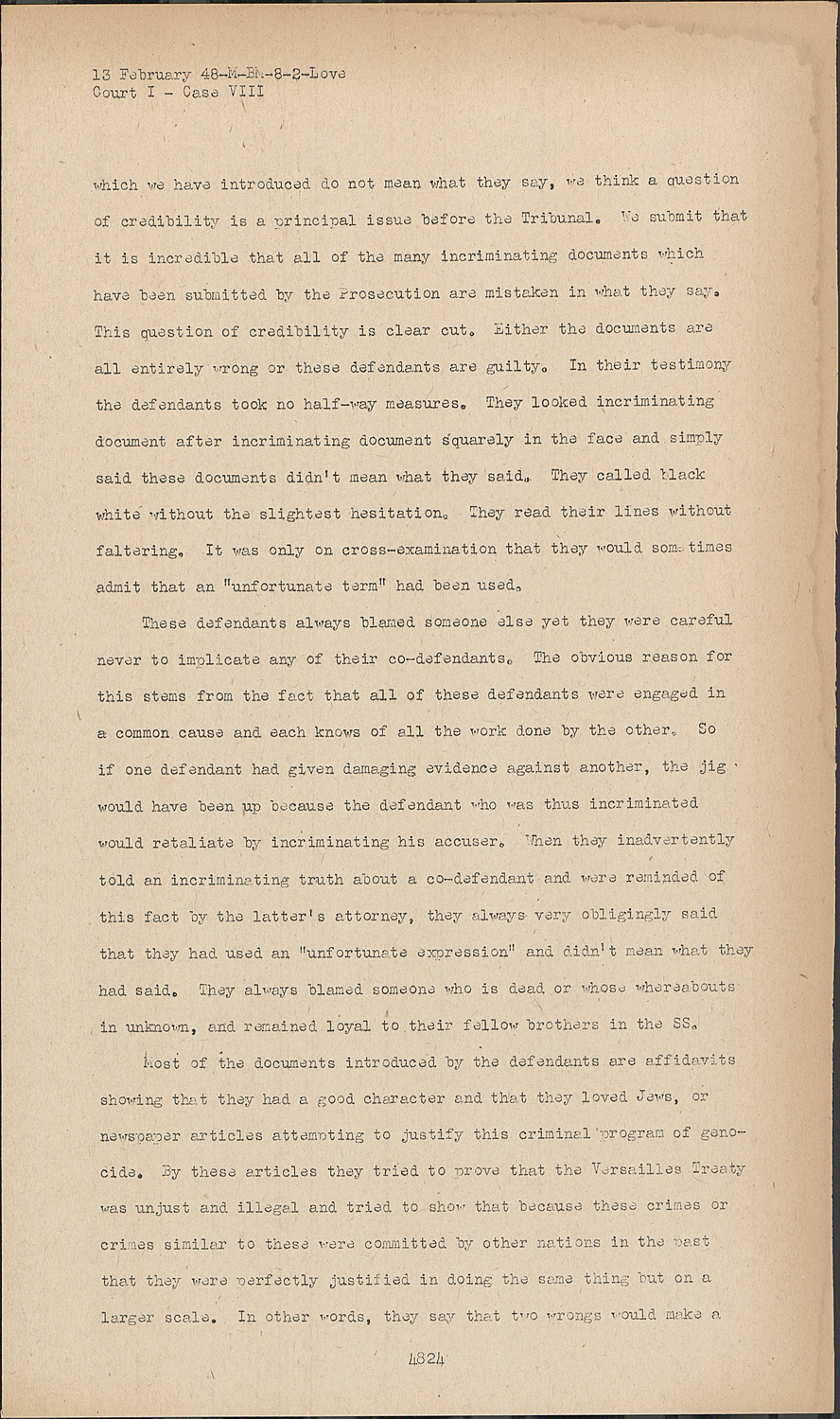
We submit that it is incredible that all of the many incriminating documents which have been submitted by the Prosecution are mistaken in what they say. This question of credibility is clear out. Either the documents are all entirely wrong or these defendants are guilty. In their testimony the defendants took no half-way measures. They looked incriminating document after incriminating document squarely in the face and simply said these documents didn't mean what they said. They called black white without the slightest hesitation. They read their lines without faltering. It was only on cross-examination that they would sometimes admit that an "unfortunate term" had been used.
These defendants always blamed someone else yet they were careful never to implicate any of their co-defendants. The obvious reason for this stems from the fact that all of these defendants were engaged in a common cause and each knows of all the work done by the other. So if one defendant had given damaging evidence against another, the jig would have been up because the defendant who was thus incriminated would retaliate by incriminating his accuser. When they inadvertently told an incriminating truth about a co-defendant and were reminded of this fact by the latter's attorney, they always very obligingly said that they had used an "unfortunate expression" and didn't mean what they had said. They always blamed someone who is dead or whose whereabouts in unknown, and remained loyal to their fellow brothers in the SS.
Most of the documents introduced by the defendants are affidavits showing that they had a good character and that they loved Jews, or newspaper articles attempting to justify this criminal program of genocide. By these articles they tried to prove that the Versailles Treaty was unjust and illegal and tried to show that because these crimes or crimes similar to these were committed by other nations in the past that they were perfectly justified in doing the same thing but on a larger scale. In other words, they say that two wrongs would make a right.
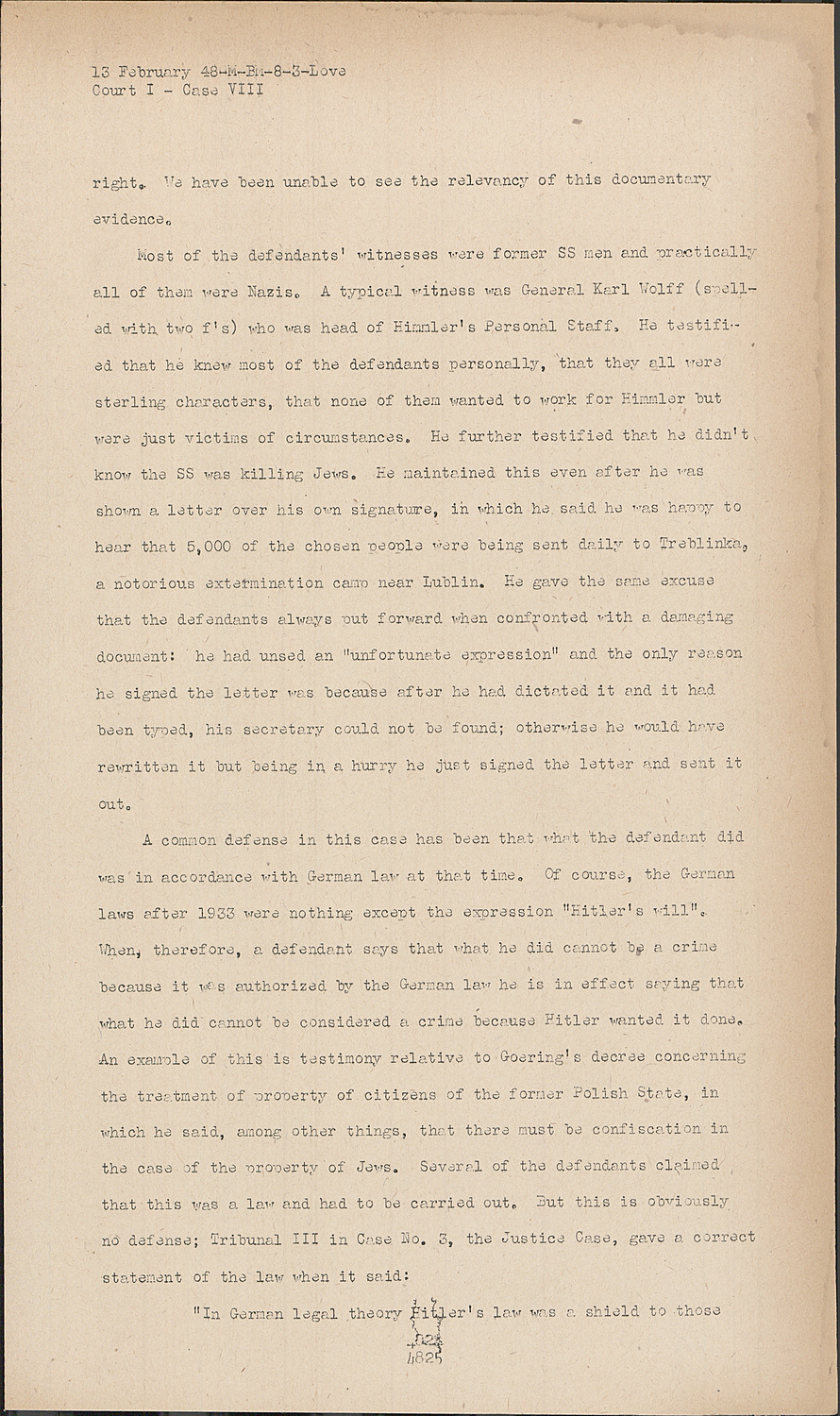
We have been unable to see the relevancy of this documentary evidence.
Most of the defendants' witnesses were former SS men and practically all of then were Nazis. A typical witness was General Karl Wolff (spelled with two f's) who was head of Himmler's Personal Staff. He testified that he knew most of the defendants personally, that they all were sterling characters, that none of them wanted to work for Himmler but were just victims of circumstances. He further testified that he didn't know the SS was killing Jews. He maintained this even after he was shown a letter over his own signature, in which he said he was happy to hear that 5,000 of the chosen people were being sent daily to Treblinka, a notorious extermination came near Lublin. He gave the same excuse that the defendants always out forward when confronted with a damaging document: he had unsed an "unfortunate expression" and the only reason he signed the letter was because after he had dictated it and it had been typed, his secretary could not be found; otherwise he would have rewritten it but being in a hurry he just signed the letter and sent it out.
A common defense in this case has been that what the defendant did was in accordance with German law at that time. Of course, the German laws after 1933 were nothing except the expression "Hitler's will". When, therefore, a defendant says that what he did cannot be a crime because it was authorized by the German law he is in effect saying that what he did cannot be considered a crime because Hitler wanted it done. An example of this is testimony relative to Goering's decree concerning the treatment property of citizens of the former Polish State, in which he said, among other things, that there must be confiscation in the case of the property of Jews. Several of the defendants claimed that this was a law and had to be carried out. But this is obviously no defense; Tribunal III in Case No. 3, the Justice Case, gave a correct statement of the law when it said:
"In German legal theory Hitler's law was a shield to those who acted under it, but before a Tribunal authorized to enforce international law, Hitler's decrees were a protection neither to the Fuehrer himself nor to his subordinates, if in violation of the law of the community or nations."
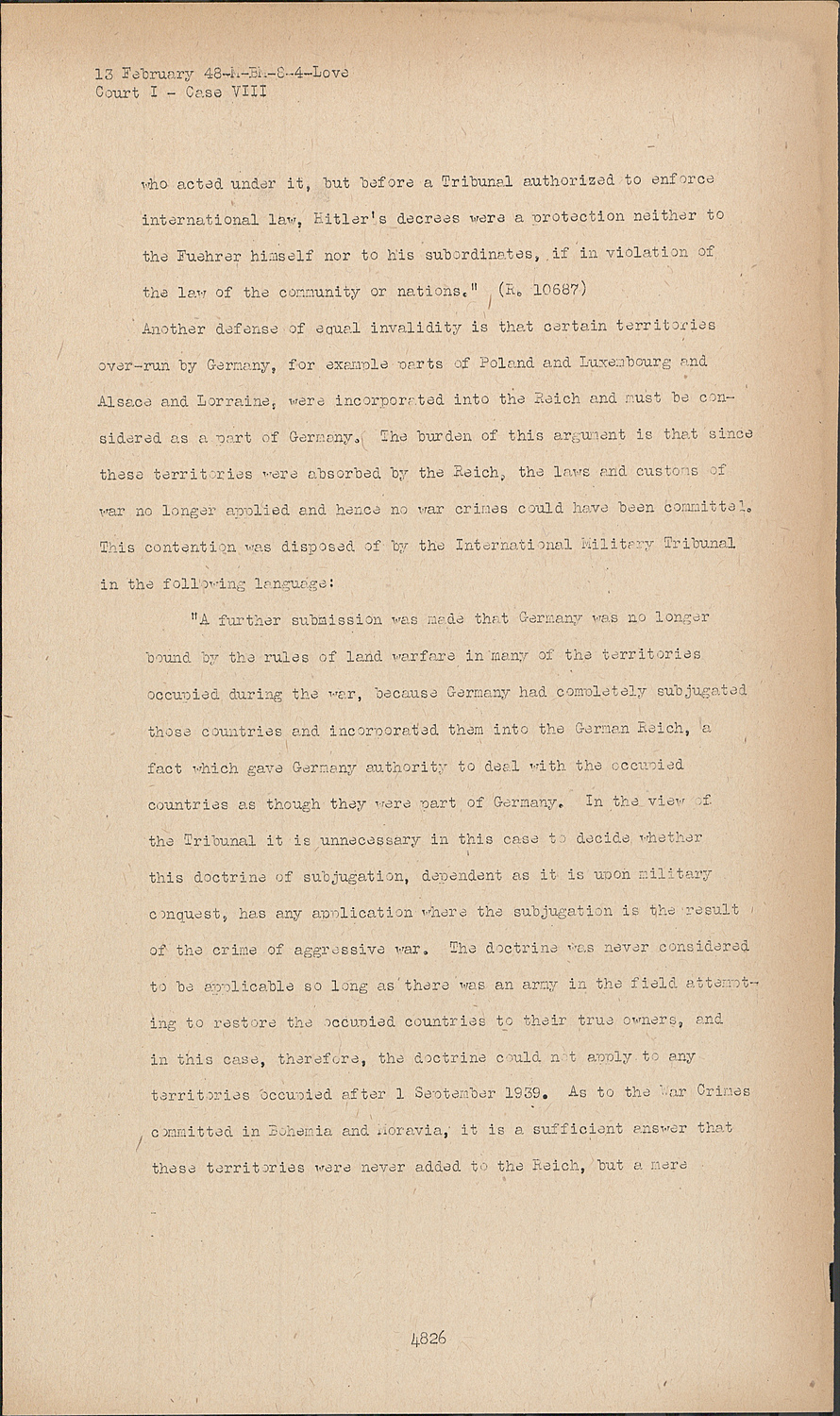
(R. 10687) Another defense of equal invalidity is that certain territories over-run by Germany, for example parts of Poland and Luxembourg and Alsace and Lorraine, were incorporated into the Reich and must be considered as a part of Germany.
The burden of this argument is that since these territories were absorbed by the Reich, the laws and customs of war no longer applied and hence no war crimes could have been committel. This contention was disposed of by the International Military Tribunal in the following language:
"A further submission was made that Germany was no longer bound by the rules of land warfare in many of the territories occupied during the war, because Germany had completely subjugated those countries and incorporated them into the German Reich, a fact which gave Germany authority to deal with the occupied countries as though they were part of Germany. In the view of the Tribunal it is unnecessary in this case to decide whether this doctrine of subjugation, dependent as it is upon military conquest, has any application where the subjugation is the result of the crime of aggressive war. The doctrine was never considered to be applicable so long as there was an army in the field attempting to restore the occupied countries to their true owners, and in this case, therefore, the doctrine could not apply to any territories occupied after 1 September 1939. As to the or Crimes committed in Bohemia and Moravia, it is a sufficient answer that these territories were never added to the Reich, but a mere protectorate was established over then."
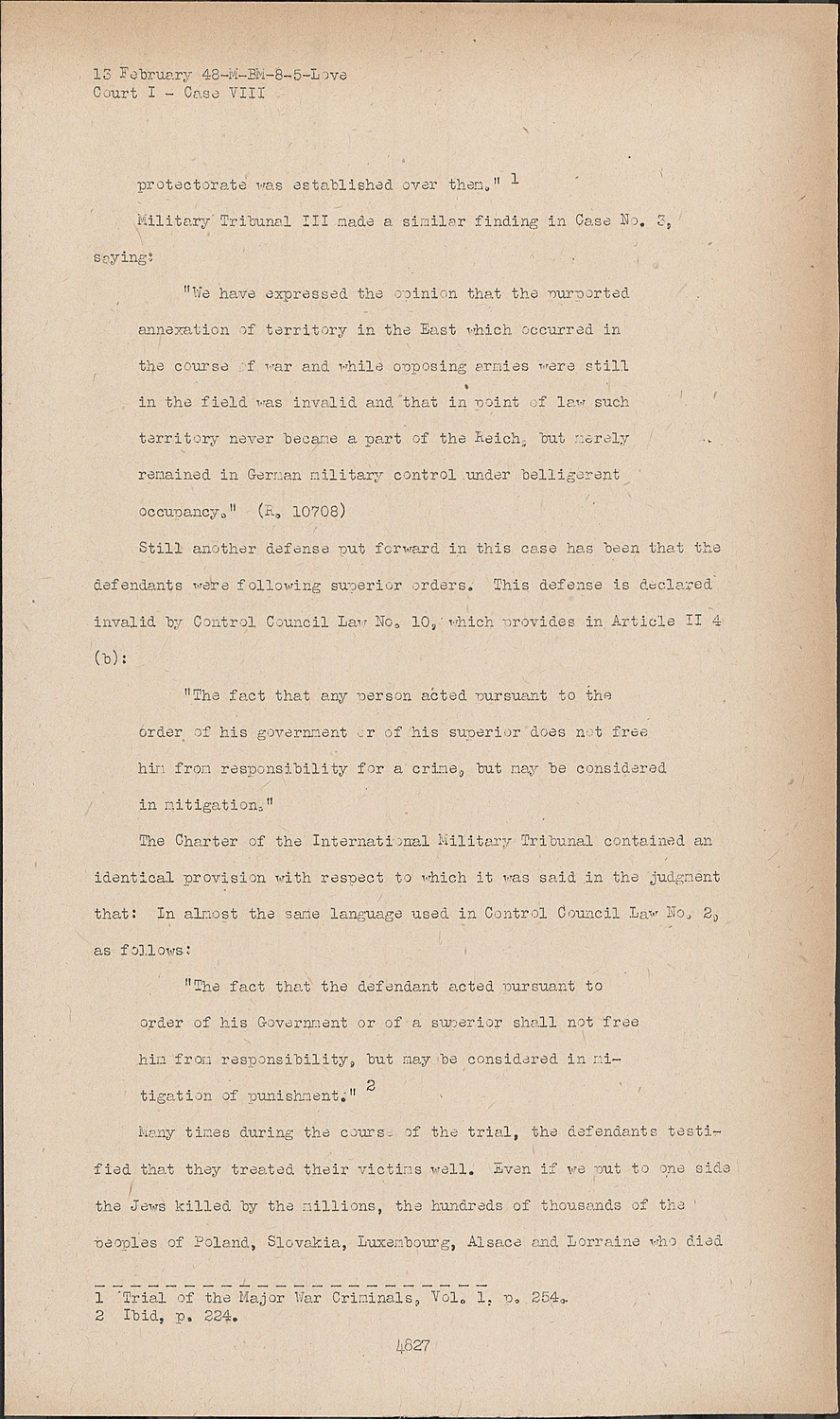
1 Military Tribunal III made a similar finding in Case No. 3, saying:
"We have expressed the opinion that the purported annexation of territory in the East which occurred in the course of war and while opposing armies were still in the field was invalid and that in point of law such territory never became a part of the Reich, but merely remained in German military control under belligerent occupancy."
(R. 10708) Still another defense put forward in this case has been that the defendants were following superior orders.
This defense is declared invalid by Control Council Law No. 10, which provides in Article II 4 (b):
"The fact that any person acted pursuant to the order of his government or of his superior does not free him from responsibility for a crime, but nay be considered in mitigation."
The Charter of the International Military Tribunal contained an identical provision with respect to which it was said in the judgment that: In almost the same language used in Control Council Law No. 2, as follows:
"The fact that the defendant acted pursuant to order of his Government or of a superior shall not free him from responsibility, but may be considered in mi tigation of punishment."
2 Many times during the course of the trial, the defendants testified that they treated their victims well.
Even if we put to one side the Jews killed by the millions, the hundreds of thousands of the peoples of Poland, Slovakia, Luxembourg, Alsace and Lorraine who died - - - - - - - - - - - - - - - - - - - - - 1 Trial of the Major War Criminals, Vol. 1, p. 254. 2 Ibid, p. 224.
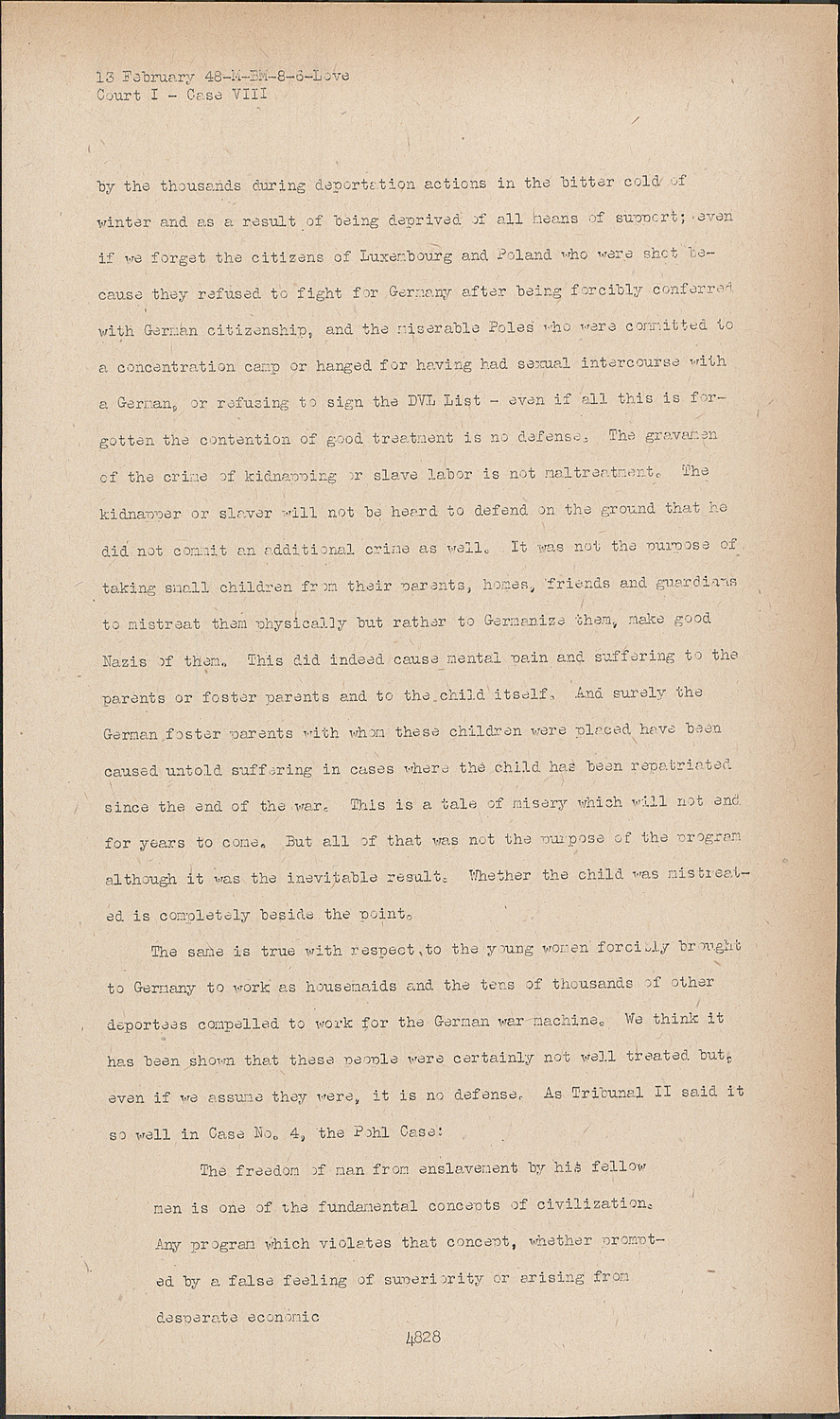
by the thousands during deportation actions in the bitter cold of winter and as a result of being deprived of all beans of support; even if we forget the citizens of Luxembourg and Poland who were shot because they refused to fight for Germany after being forcibly conferred with German citizenship, and the miserable Poles who were committed to a concentration camp or hanged for having had sexual intercourse with a German. or refusing to sign the DVL List - even if all this is forgotten the contention of good treatment is no defense. The gravamen of the crime of kidnapping or slave labor is not maltreatment. The kidnapper or slaver will not be heard to defend on the ground that he did not commit an additional crime as well. It was not the purpose of taking small children from their parents, homes, friends and guardians to mistreat them physically but rather to Germanize them, make good Nazis of them. This did indeed cause mental pain and suffering to the parents or foster parents and to the child itself. And surely the German foster parents with whom these children were placed have been caused untold suffering in cases where the child has been repatriated since the end of the war. This is a tale of misery which will not end for years to come. But all of that was not the purpose of the program although it was the inevitable result. Whether the child was mistreated is completely beside the point.
The same is true with respect to the young women forcibly brought to Germany to work as housemaids and the tens of thousands of other deportees compelled to work for the German war machine. We think it has been shown that these people were certainly not well treated but, even if we assume they were, it is no defense. As Tribunal II said it so well in Case No. 4, the Pohl Case:
The freedom of man from enslavement by his fellow men is one of the fundamental concepts of civilization.
Any program which violates that concept, whether prompt ed by a false feeling of superiority or arising from desperate economic COURT NO.
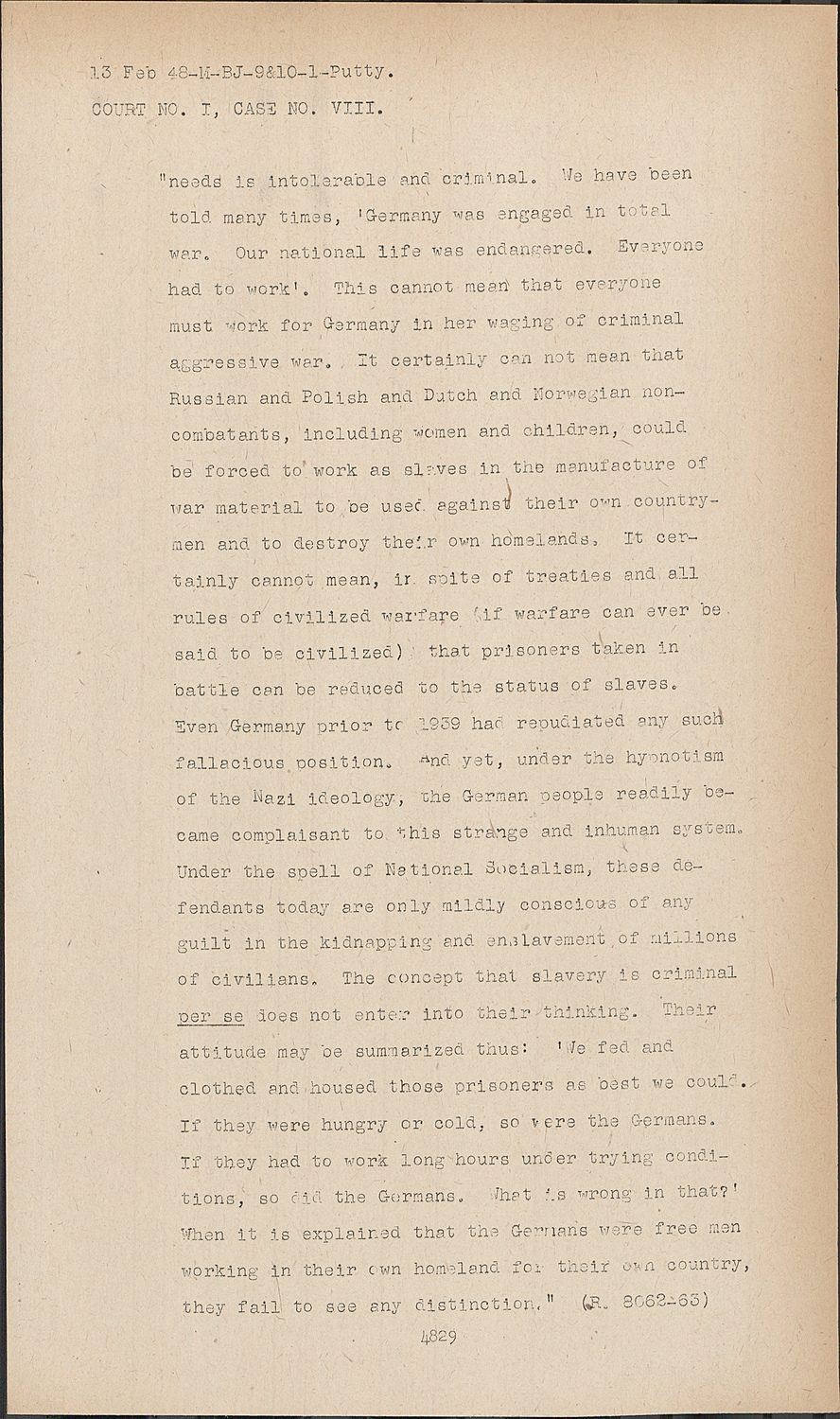
I, CASE NO. VIII.
"needs is intolerable and criminal. We have been told many times, 'Germany was engaged in total war.
Our national life was endangered. Everyone had to work'. This cannot mean that everyone must work for Germany in her waging of criminal aggressive war.
It certainly can not mean that Russian and Polish and Dutch and Norwegian non combatants, including women and children, could be forced to work as slaves in the manufacture of war material to be used against their own country men and to destroy their own homelands.
It cer tainly cannot mean, in spite of treaties and all rules of civilized warfare if warfare can ever be said to be civilized) that prisoners taken in battle can be reduced to the status of slaves.
Even Germany prior to 1939 had repudiated any such fallacious position.
And yet, under the hypnotism of the Nazi ideology, the German people readily be came complaisant to this strange and inhuman system.
Under the spell of National Socialism, these de fendants today are only mildly conscious of any guilt in the kidnapping and enslavement of millions of civilians.
The concept that slavery is criminal per se does not enter into their thinking.
Their attitude may be summarized thus:
We fed and clothed and housed those prisoners as best we could.
If they were hungry or cold, so were the Germans.
If they had to work long hours under trying condi tions, so did the Germans.
What is wrong in that?
When it is explained that the Germans were free men working in their own homeland for their own country, they fail to see any distinction."
(R. 8062-63) Another contention of the defendants was that the so-called "ethnic Germans" were In fact Germans and subject to the jurisdiction of the German government.
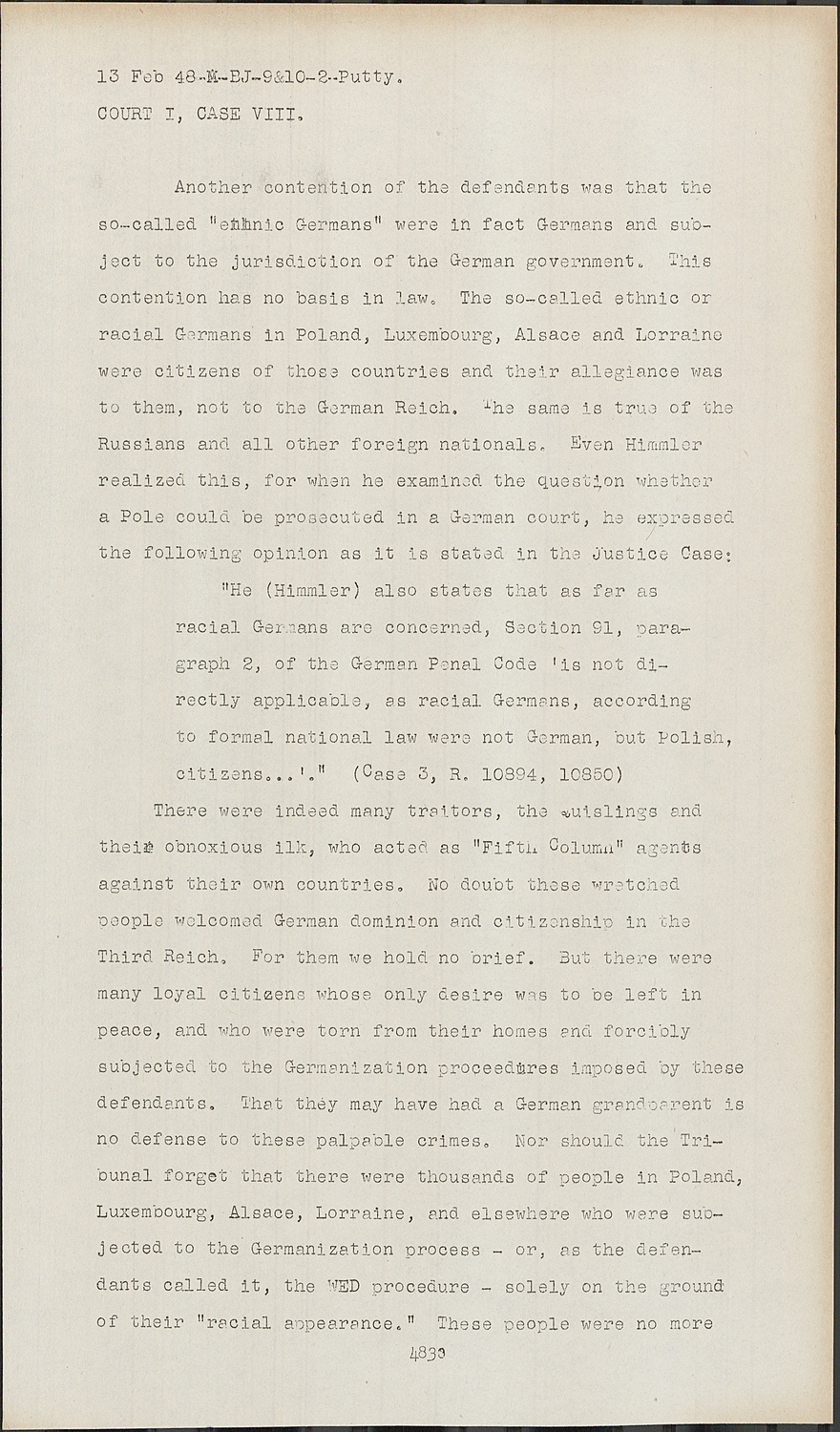
This contention has no basis in law. The so-called ethnic or racial Germans in Poland, Luxembourg, Alsace and Lorraine were citizens of those countries and their allegiance was to them, not to the German Reich. The same is true of the Russians and all other foreign nationals. Even Himmler realized this, for when he examined the question whether a Pole could be prosecuted in a German court, he expressed the following opinion as it is stated in the justice Case:
"He (Himmler) also states that as far as racial Germans are concerned, Section 91, para graph 2, of the German Penal Code 'is not di rectly applicable, as racial Germans, according to formal national law were not German, but Polish, citizens.
..'." (Case 3, R. 10894, 10850) There were indeed many traitors, the quislings and their obnoxious ilk, who acted as "Fifth Column" agents against their own countries.
No doubt these wretched people welcomed German dominion and citizenship in the Third Reich. For them we hold no brief. But there were many loyal citizens whose only desire was to be left in peace, and who were torn from their homes and forcibly subjected to the Germanization proceedures imposed by these defendants. That they may have had a German grandparent is no defense to these palpable crimes. Nor should the Tribunal forget that there were thousands of people in Poland, Luxembourg, Alsace, Lorraine, and elsewhere who were subjected to the Germanization process - or, as the defendants called it, the WED procedure - solely on the ground of their "racial appearance." These people were no more German than Tam O'Shanter.
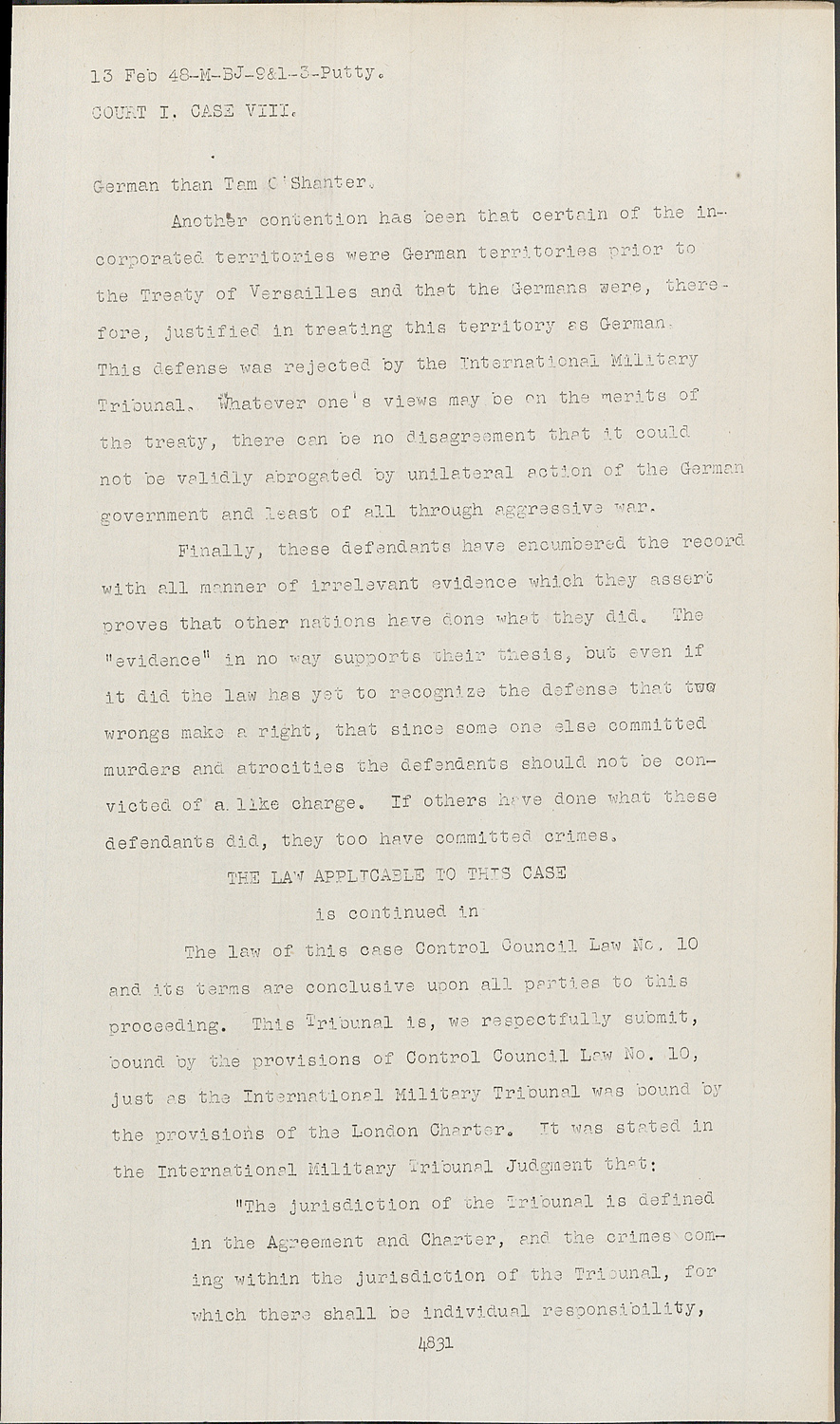
Another contention has been that certain of the incorporated territories were German territories prior to the Treaty of Versailles and that the Germans were, therefore, justified in treating this territory as German This defense was rejected by the International Military Tribunal, Whatever one's views may be on the merits of the treaty, there can be no disagreement that it could not be validly abrogated by unilateral action of the German government and least of all through aggressive war.
Finally, these defendants have encumbered the record with all manner of irrelevant evidence which they assert proves that other nations have done what they did. The "evidence" in no way supports their thesis, out even if it did the law has yet to recognize the defense that two wrongs make a right, that since some one else committed murders and atrocities the defendants should not be convicted of a like charge. If others have done what these defendants did, they too have committed crimes.
THE LAW APPLICABLE TO THIS CASE is continued in The law of this case Control Council Law No. 10 and its terms are conclusive upon all parties to this proceeding.
This Tribunal is, we respectfully submit, bound, by the provisions of Control Council Law No. 10, just as the International Military Tribunal was bound by the provisions of the London Charter. It was stated in the International Military Tribunal Judgment that:
"The jurisdiction of the Tribunal is defined in the Agreement and Charter, and the crimes coming within the jurisdiction of the Tribunal, for which there shall be individual responsibility, "are set out in Article 6... The law of the Charter is decisive and binding upon the Tri bunal.
.."1 It will perhaps be helpful at this point for the Prosecution to outline briefly its conception of the legal principles underlying War Crimes and Crimes against Humanity as defined in Control Council Law No. 10.
War Crimes are defined in Control Council Law No. 10 as atrocities and offenses in violation of the laws and customs of war. This definition is based primarily on the Hague Convention of 1929, which declare the law of nations at those times with respect to land warfare, the treatment of prisoners of war, the rights and duties of a belligerent power when occupying territory of a hostile state, and other matters.
It has been contended by some here, as it was contended in the trial before the International Military Tribunal, that the Hague Convention does not apply in this case because several of the belligerents in the recent war were not parties to the Convention. In its Judgment, the International Military Tribunal disposed of this contention with the following language:
"The Tribunal is of course bound by the Charter, in the definition which it gives both of War Crimes and Crimes against Humanity.
With respect to War Crimes, however, as has already been pointed out, the crimes defined by Article 6, Section (b), of the Charter were already recognized as War Crimes under international law.
They were covered by Articles 46, 50, 52 and 56 of the Hague Convention of 1907, and - - - - - - - - - - - 1. Trial of the Major War Criminals, Vol.
1, pp. 218, 253.
"Articles 2, 3, 4, 46 and 51 of the Geneva Con vention of 1929.
That violation of these pro visions constituted crimes for which the guilty individuals were punishable is too will-settled to admit of argument.
"But it is argued that the Hague Convention does not apply in this case, because of the 'general participation' clause in Article 2 of the Hague Convention of 1907.
That clause pro vided:
'The provisions contained in the regu lations (Rules of Land Warfare) referred to in Article I as well as in the present Convention do not apply except between con tracting powers, and then only if all the belligerents are parties to the Convention.
Several of the belligerents in the recent war were not parties to this Convention.
"In the opinion of the Tribunal it is not necessary to decide this question.
The rules of land warfare expressed in the Convention undoubtedly represented an advance over existing international law at the time of their adoption.
But the Con vention expressly stated that it was an attempt 'to revise the general laws and customs of war', which it thus recognized to be then existing, but by 1939 these rules laid down in the Convention were recognized by all civilized nations, and were regarded as being declaratory of the laws and customs of war which are referred to in Article 6 (b) of the Charter."
1 - - - - - - - - - - - 1. Trial of the Major War Criminals, Vol. 1, pp. 283-4.
The laws and customs of war apply between belligerents, but now domestically or among allies. Crimes of German nationals against other German nationals are not War Crimes, nor are acts by German nationals against their allies. But these crimes are comprehended within the definition of Crimes against Humanity as contained both in the London Charter of the International Military Tribunal and Control Council Law No. 10 for this proceeding. The definition of Crimes against Humanity as contained in Control Council Law No. 10 is:
"Atrocities and offenses, including but not limited to, murder, extermination, enslavement, deportation, imprisonment, torture, rape, or other inhumane acts committed against any civilian popu lation, or persecutions on political, racial or religious grounds whether or not in violation of the domestic laws of the country where perpetrated."
The definition of Crimes Against Humanity is thus considerably broader than that of War Crimes. Crimes against Humanity include atrocities and offenses against any civilian population, while War Crimes are limited to crimes committed against the civilian population from occupied territory. Thus, a War Crime is necessarily at the same time a Crime against Humanity; the reverse of this proposition is of course not true since Crimes against Humanity committed against Germans or allies of Germany are not at the same time War Crimes. This analysis is recognized not only in Case No. 3, the Justice Case, but also in the judgment of the International Military Tribunal - as stated by Military Tribunal III in its judgment:
"Obviously, these sections are not surplus age.
They supplement the preceding sections on "war crimes and include within their prohibition not only war crimes, but also acts not included within the preceding definitions of war crimes.
In place of atrocities committed against civil ians of or in or from occupied territory, these sections prohibit atrocities 'against any civil ian population'... Article III of Control Coun cil Law No. 10 clearly demonstrates that acts by Germans against German nationals may constitute crimes against humanity within the jurisdiction of this Tribunal to punish.
"Control Council Law No. 10 is not limited to the punishment off persons guilty of violating the laws and customs of war in the narrow sense;furthermore, it can no longer be said that vio lations of the laws and customs of war are the only offenses recognized by common international law.
The force of circumstances, the grim fact of world-wide interdependence, and the moral pressure of public opinion have resulted in inter national recognition that certain crimes against humanity committed by Nazi authority against Ger man nationals constitute violations not alone of statute but also of common international law."
1 The Judgment of the International Military Tribunal also shows a clear recognition of its jurisdiction over crimes of Germans against Germans as comprehended within the definition of Crimes against Humanity.
After reviewing a large number of inhumane acts in connection with War Crimes and Crimes against Humanity, the Tribunal - - - - - - - - - - - - 1. U.S. vs Josef Alstoetter, et al, Case No. 3, M.T. III, pp.
23-4 & 31.
concluded by saying that:
"... from the beginning of the war in 1939 War Crimes were committed on a vast scale, which were also Crimes against Humanity; and insofar as the inhumane acts charged in the Indictment, and committed after the beginning of the war, did not constitute War Crimes; they were all committed in execution of, or in connection with, the aggres sive war, and therefore constituted Crimes against Humanity."
1 What we have said with respect to the broad scope of the definition of Crimes against Humanity has primary significance with respect to Paragraph 22 of Count One of the Indictment.
It charges the defendant Hildebrandt with the extermination of thousands of German nationals pursuant to the so-called euthanasia program of the Third Reich. All other acts charged as Crimes against Humanity in the Indictment were also directed against civilians from occupied countries, and consequently are also charged as, and constitute, War Crimes. The evidence does not reveal, however, whether the persons executed by the SS unit commanded by Hildebrandt when he was Higher SS and Police Leader in Danzig, West Prussia, were all German nationals, or whether some Polish nationals also fell victim to this action. Accordingly, these murders were charged in the Indictment only as Crimes against Humanity. According to the definition of Crimes against Humanity, as contained in Control Council Law No. 10, this Tribunal clearly has jurisdiction over this crime even though it may have been committed only against German nationsls. - - - - - - - - - 1. Trial of the Major War Criminals, Vol. 1, p. 254.
This very matter has been authoritatively determined by the judgment of the International Military Tribunal when it said that:
"Reference should also be mode to the policy which was in existence in Germany by the summer of 1940, under which call aged, insane, and incur able people, 'useless eaters', were transferred to special institutions where they were killed, and their relatives informed that they had died from natural causes.
The victims were not confined to German citizens, out included foreign laborers, who were no longer able to work, and were there fore useless to the German war machine.
It has been estimated that at least some 275,000 people were killed in this manner in nursing homes, hos pitals and asylums, which were under the juris diction of the Defendant Frick, in his capacity as Minister of the Inferior.
How many foreign workers were included in this total it has been quite impossible to determine.
"During the war nursing homes, hospitals and asylums in which euthanasia was practiced as described elsewhere in this Judgment, came under Frick's jurisdiction.
He had knowledge that insane, sick and aged people, useless eaters', were being systematically out to death.
Complaints of these murders reached him, but he did nothing to stop them.
A report of the Czecho slovak War Crimes Commission estimated that 275,000 mentally deficient and aged people, for whose wel fare he was responsible, fell victim to it."
1 - - - - - - -- - - - - - - 1. Trial of the Major War Criminals, Vol. 1, pp. 247-301.
Thus, the International Military Tribunal held that the crime of euthanasia, as widely practiced by the Third Reich was a crime within its jurisdiction and not distinction was drawn as to the nationality of the persons who fell victims to it. A similiar result was reached by Military Tribunal I, in Case No. 1, the so-called Medical Case.
We will now cite a few precedents to show that the very things which these defendants are charged with have been declared to be crimes.
As to the criminality of the acts charged in the Indictment, no novel questions face the Tribunal. That these acts did occur and that they constitute crimes has been authoritatively adjudicated by the International Military Tribunal and by other tribunals which have rendered judgments here at Nurnberg. Article 9 of Military Government Ordinance No. 7 provides that tribunals shall take judicial knowledge of the records and findings of other tribunals of any of the Unted Nations. Article 10 provides that a determination of the International Military Tribunal in the Judgment in Case No. 1 that certain crimes were planned or occurred shall be binding on the tribunals established under Ordinance No. 7, and statements of the International Military Tribunal in its Judgment shall constitute proof of acts stated in the absence of substantial new evidence to the contrary.
We will quote a few excerpts from the Judgment in Case No. 1 which are proof of the fact that not only were these crimes planned but they were actually committed in accordance with the pre-conceived plan.
The International Military Tribunal has held that criminal acts of expulsion were committed in order to make room for German colonization, and the Tribunal stated;"... In Poland and the Soviet Union these crimes were part of a plan to get rid of whole native popu lations by expulsion and annihilation, in order that their territory could be used for colonization by Germans.
Hitler had written in Mein Kampf on these lines, and the plan was clearly stated by Himmler in 1942, when he wrote:
'It is not our task to German ize the East in the old sense, that is to teach the people there the German language and the German law, but to see to it that only people of purely Germanic blood live in the East'."1 The same Tribunal, referring to the abduction of children of a conquered nation, said:
"It was Himmler again who stated in October 1943:
'... What the nations can offer in the way of good blood of our type, we will take.
If necessary, by kidnapping their children and raising them here with us.
Whether nations live in prosperity or starve to death interests me only insofar as we we need them as slaves for our culture, otherwise it is of no interest to me'."2 The Tribunal again adjudged that expulsions and deportations actually occurred:
"In the West the population of Alsace were the victims of a German 'expulsion action'. Between July and December 1940, 105,000 Alsatians were either deported from their homes or prevented from returning to them.
A captured German report dated 7 August 1942 with regard to Alsace states that:
- - - - - - - - - - - - 1. Trial of the Major War Criminals, Vol. 1, p. 237. 2. Trial of the Major War Criminals, Vol. 1, p. 237.
'The Problem of race will be given first consider ation, and this in such a manner that persons of racial value will be deported to Germany proper, and racially inferior persons to France'."1 The International Military Tribunal also determined that plunder has been committed in connection with the program for the Strengthening of Germanism.
Again we quote:
".... Himmler, as the Reich Commissioner for the 'Strengthening of Germanism', issued a decree.
..
for carrying out the art seizure program. It Stated:
'To strengthen Germanism in the defense of the Reich, all articles mentioned in Section 2 of this decree are hereby confiscated.
..'." - - - - - - - - - - 1. Ibid, p. 238.
They are confiscated for the benefit of the German Reich, and are at the disposal of the Reich Commissioner for the strengthening of Germanism".1 The International Military Tribunal referred to RUSHA and VOMI as criminal components of the SS Supreme Command, holding that they:
"were active in carrying out schemes for Germanization of occupied territories according to the racial principles of the Nazi Party and were involved in the deportation of Jews and other foreign nationals."
2 In condemning the Leadership Corps of the Nazi Party, the Tribunal said:
"But the Leadership Corps was also used for similar steps in Austria and those parts of Czechoslovakia, Lithuania, Poland, France, Belgium, Luxembourg and Uygoslavia.
... The Leadership Corps was used for their Germanization through the elimination of local customs.
..."3 (Underscoring curs).
In its judgment against Hess, the Tribunal said that:
"He signed decrees forcing certain groups of Poles to accept German citizenship.
The Tribunal however, does not find that the evidence sufficiently connects Hess with these crimes to sustain a finding of guilt."
4 So, although the Tribunal did not pin the guilt for these particular crimes on Hess, it did adjudicate the fact that the forcing of persons to accept German citizenship was a crime.
--------1. Trial of the Major War Criminals, Vol. 1. p. 242. 2. Ibid, Vol. 1, p. 270. 3. Ibid, Vol. 1, pp. 258-9. 4. Ibid, Vol. 1, p. 284.
In citing the crimes committed by the defendant Rosenberg, the Tribunal held that:
"He helped to formulate the policies of Germanization ..
and he set up the administration which carried them out."1 And, finally, the Tribunal in its judgment against the defendant Frich said:
"Having created a racial register of persons of German extraction, Frick conferred German citizenship on certain groups of citizens Of foreign countries.
He is responsible for German9 zation in Austria, Sudetenland, Memel, Danzig, Eastern territories (West Prussia and Posen), and Eupen, Malmedy, and Moresnot.
He forced on the citizens of these territories German law, German courts, German education, German police security, and compulsory military service."
2 CONCLUSION In conclusion we respectfully submit that it has been shown that during the course of the late war many heinous crimes were committed by the Nazi regime against the civilian population of neighboring countries.
It has been shown that these crimes were committed for the purpose of making Germany strong by making her meighbors weak. It has been shown that with the cessation of Polish armed resistance in October 1939, Hitler and Himmler took steps to destroy the Polish nation and large groups of its peoples. It has been shown that a special office was set up to carry out this gigantic task; that the office was known as the Office of the Reich Commissar for the Strengthening of Germanism (later known as the Main Staff Office) and that the Nazi Party and SS agencies, RUSHA, VOMI and Lebensborn, were detailed to assist in the execution of the ---------1. Trial of the Major War Criminals, Vol. 1, p. 295. 2. Ibid, Vol. 1, p. 301.
program, It has been shown that these four offices, working in perfect harmony and in collaboration one with the other and under the overall supervision of the Main Staff Office were responsible for the many criminal acts which were perpetrated in connection with the program. It has been shown that all of the defendants, as important ad high ranking officials of these four offices worked together to effectuate this criminal common plan. These defendants conferred together, discussed together, planned together, and worked together. Each was an expert in his own field. They comprised a team and each member was vital to the success of the whole enormous operation. Their tasks were so interwoven and so interrelated that without complete knowledge of the entire program and without full collaboration on the part of all, they would not have been able to accomplish what they did in carrying cut this criminal program. So we repeat, these defendants constitute a team, they all were involved in one scheme. They are all responsible for the criminal acts which they committed in carrying out the program.
Control Council Law No. 10, Article II 2 provides that without regard to the capacity in which he acted any person is deemed to have committed a crime as defined in Control Council Law No. 10 if he was (a) a principal or (b) was an accessory to the commission of any such crime or ordered or abetted the same or (c) took a consenting part therein or (d) was connected with plans or enterprises involving its commission or (e) was a member of any organization or group connected with the commission of any such crime.
We submit that the proof in this case shows beyond a reasonable doubt that all the defendants have participated in the crimes charged in the Indictment in such a way as to bring them within the provisions above quoted and that they, therefore are guilty of having committed the crimes charged.