This is the photostatic copy of a memorandum directed to Eastern workers, an excerpt from the general collection of decrees.
Hofmann Document No. 54 I submit as Exhibit 61, an excerpt from the Information Service of the Racial-Political Office of the NSDAP, concerning the legislation for the protection of the race in other countries.
As Exhibit No. 62 I offer Hofmann Document No. 55; this is an excerpt from the book, Blood and Race in Legislation, by Johann v Leers.
Hofmann Document No. 56, which will become Exhibit 63, is an excerpt from the book The Black Migration, by Manfred Sell.
Hofmann Document No. 57 will become Exhibit 64; it is an excerpt from the Commonweal, from the issue of September 1947, referring to racial segregation laws.
My next exhibit will be Hofmann Document No. 59 and is to become Exhibit 65; this is an affidavit by Herbert Kaehne, concerning the activities of the field office in Lodz. It also concerns the punishment of SS men for violation of the order concerning unlawful sexual intercourse with Polish women.
Hofmann Document No. 60 is supposed to become Exhibit 66. This is an excerpt also from this general collection of decrees and is dated 20th February 1942. It concerns the competency in special treatment cases.
Hofmann Document No. 62 is to become Exhibit No. 68; it is an order of the Reich Security Main Office, dated 27th May 1942.
Hofmann Document No. 63 is to become Hofmann Exhibit No. 69. This is an excerpt from the general collection of decrees, and it is a decree of the Reich Security Main Office dated 18th July 1942.
Hofmann Document No. 64 will become Exhibit 70; it is an order by the Reich Security Main Office, dated 7th December, 1942; it is also an excerpt originating from the general collection of decrees.
Hofmann Document No. 65 will become Exhibit 71; it is an excerpt from the general collection of decrees, dated 12th February 1943.
Hofmann Document No. 66 is to become Exhibit 72, and it is a letter of the Ministry of Justice concerning treatment of prisoners of war.
Hofmann Document No. 67 is to become Exhibit No. 73; this is an excerpt from the general collection of decrees, dated 4th May 1943.
Hofmann Document No. 68 will become Exhibit 74; it is an excerpt from the general collection of decrees dated 10th September 1943.
The next document I already offered as Exhibit 15; it bears the Document No. 69.
The next document, No. 70, is to become Exhibit 75. This is a photostatic copy from the newspaper Schwaebische Illustrierto.
The next document, Hofmann Document No. 71, is to become Exhibit 76. It is a copy from the book, the German Police, and it concerns the competency of the Gestapo.
Hofmann Document No. 72 will become Exhibit 77. This is an excerpt from Document 1063-PS. It contains some information issued by the Reich Security Main Office.
Hofmann Document No. 73 will become Exhibit 78. It contains an official order for the Security Police.
Document Hofmann No. 74 will become Exhibit 79. It is an excerpt from the book, German Administrative Law, by Dr. Hans Frank. It concerns the activities of the political police, and also concerns the problem of racial treatment.
Hofmann Document No. 75 will become Exhibit 80, and it is a copy of the decree for the protection of matrimonial life, the family and motherhood.
My next document, Hofmann Document No. 76, I already submitted as Exhibit 16. It is an affidavit by Erhard Mueller, dated 13 December 1947.
My next document, Hofmann Document No. 77, is to become Exhibit 81.

This is an excerpt from the order prohibiting fraternization, issued by the allied Expeditionary Force, and dated 12th September 1944.
Court No. I, Case No. VIII.
The next two documents--Nos. 78 and 79--were already submitted by me as Exhibits 17 and 18, respectively. These are the affidavits by Margarete Roth and Irene Pflueger.
Document Hofmann No. 80 I would like to submit as Exhibit 82. It is an excerpt from the newspaper "Neue Tag" (New Day), dated 12 July 1947.
I have now finished with Document Book III-A, and I would now like to turn to Document Book III-B. This document book is especially concerned with regermanization. Already at the beginning of my presentation, I submitted Hofmann Document 81 as Exhibit 12. This is an affidavit by Adolf von Bomhard. Document No. 82, an affidavit by Erhard Mueller, will become Exhibit 13. I have already submitted that.
The following document numbers now will correspond to the exhibit numbers. They are: No. 83, an excerpt from the book "Der Menscheneinsatz" (Allocation of Manpower), a letter of Greifelt, directed to the Higher SS and Police Leader, of 31 July 1940, concerning the treatment of persons suitable for regermanization.
Exhibit 84 will be an excerpt from the book "Der Menscheneinsatz", Pages 58 and 59.
Exhibit 85 is an excerpt from the book "Der Menscheneinsatz", which is a letter from Greifelt to the Reich Minister of Economics, of 2 October 1940, concerning the care of people included in the regermanization procedure.
Exhibit 86 will become an excerpt from the book "Der Menscheneinsatz," which is a letter to the Reich Minister of Labor, dated 5 November 1940.
Exhibit 87 is an excerpt from the book "Der Menscheneinsatz," which contains the memorandum for plant managers, concerning the employment and use of people suitable for regermanization.
My exhibit 88 will become an affidavit by Henrich Wolff, concerning the establishment of the Riedlingen camp.
Court No. I, Case No. VIII.
As Exhibit 89 I am submitting an affidavit by Hanna Schwegler, concerning the economic administration within the framework of the regermanization procedure.
Exhibit 90 will be an affidavit by Heinrich Blanc, concerning the treatment of people judged suitable for regermanization.
Exhibit 91 will be an affidavit by Rosa Hummel, also concerning the treatment of people judged suitable for regermanization.
Exhibit 92 is an affidavit by Berta Kussmaul, also concerning the treatment of people suitable for regermanization.
Exhibit 93 is an affidavit by Stanislawa Eisele, nee Kosstur, concerning the treatment of people suitable for regermanization.
Exhibit 94 is an affidavit by Hans Mueller, concerning the treatment of Alsatians within the area of the Higher SS and Police Leader Southwest.
Exhibit 95 is an excerpt from "The Commonweal", Issue No. 25 of the year 1947.
Exhibit 96 is an affidavit by Anni Linde, concerning abortions.
Exhibit 97 is an excerpt from the newspaper "Die Badischen Neuesten Nachrichten," of 9 December 1947.
As Exhibit 98 I am submitting a Prosecution document. It is Document NO-3996, which, as far as I know, was not submitted by the Prosecution. This is a report concerning the regermanization procedure, and, among other areas, it is also concerned with the area of the Higher SS and Police Leader Southwest.
My Exhibit 99 will become an affidavit by Georg Albrecht, concerning the volunteers for regermanization.
I am now turning to Document Book IV, and I should like to continue with Document Hofmann No. 100, which will become Exhibit 100. This is an excerpt from the "Gazette of the Chief of Security Police and Security Service." In connection with this document I would like to state that this whole document book is supposed to be concerned altogether with plundering and spoliation.
Court No. I, Case No. VIII.
As my Exhibit 101 I would like to submit an excerpt from Document No. EC-410, concerning the powers of confiscation by way of the Main Trustee Office East.
My Exhibit 102 will become an excerpt from the book "Outlines of Private and Public Law, as well as of International Economics" (Grundriss des privaten and oeffentlichen Rechts, sowie der Voelkerwirtschaftslehre), by Schaeffer and Dr. Brode.
Exhibit 103 will be an excerpt from "Die Neue Zeitung," of 25 July 1947.
As Exhibit 104 I am also submitting an excerpt from "Die Neue Zeitung," dated 11 August 1947.
Exhibit 105 will become an excerpt from the book "Das Recht der Landkriegfuehrung" (The Law of Land Warfare), by Dr. Alfons Waltzog.
My Exhibit 106 will become an excerpt from the newspaper "Voelkischer Beobachter," dated 28 February 1942 and also 1 March 1942. This concerns the agrarian order for the occupied Eastern territories.
My Exhibit 107 will become an excerpt from the book, "Private Rights and Interests in the Peace Treaty" (Die privaten Rechte und Interessen im Friedensvertrag), by Dr. Hermann Isay.
I would like to leave out Document Hofmann No. 108, and would like to submit Document Hofmann No. 109 as Exhibit 108. This is an affidavit by Oswald Pohl, concerning redistribution of farmlands in the occupied Eastern territories, the relationship between the Main Economic and Administrative Office and the RuSHA Settlement Office.
Hofmann Document No. 110 will become Exhibit 109. It is an affidavit by Dr. Leo Reichert.
Exhibit 110 will become Hofmann Document No. 111, an excerpt from the official gazette of the Waffen SS, of 15 December 1940, concerning the settlement of members of the Waffen SS in the new Reich Court No. I, Case No. VIII.
territories.
Exhibit 111 will become Hofmann Document No. 112, an excerpt from the official gazette of the Waffen SS, dated 1 June 1943, concerning the interpretation of the directives of the Army High Command, concerning registration, selection, and direction of settlers for the Waffen SS.
As Exhibit 112 I am submitting Hofmann Document No. 113. I would not like to submit this document; it has already been submitted; therefore, I would now like to turn to Document Book V.
THE PRESIDENT:A little later. The Tribunal will recess until 1:30.
(The Tribunal recessed at 1215 to resume at 0130.)
AFTERNOON SESSION.
(The tribunal reconvened at 1330 hours, 22 January 1948)
THE MARSHAL:The Tribunal is again in session.
THE PRESIDENT:Proceed.
DR.SCHWARZ(Counsel for the defendant Hofmann): Your Honor, I would like to make a correction here, and I have been informed of this matter by the Prosecution.
This morning I stated, in the case of Exhibit No. 98, in Document No. 3998 was not submitted as an Exhibit. I have now ascertained that it was submitted later on, during cross-examination, as Exhibit 804. At the time when I compiled my document, however, it had not as yet been offered.
Then, I have another correction to make. This concerns Hofmann Exhibit No. 71, in Document Book III-A, and this is Document No. 65. I had already offered that as Exhibit No. 2 during the examination of the Defendant Hofmann, and therefore the Exhibit No. 71 will be withdrawn.
I shall now continue with Document Book V.
My next Exhibit will be 112. This is Hofmann Document No. 114, and it is an affidavit of Henning von Nordeck, concerning Hofmann's persecution by Streicher.
My next Exhibit will be 113. This is Hofmann Document No. 115 which is an affidavit of Anni Schneider concerning Hofmann.
My next affidavit will be 114, which is Hofmann Document No. 116. This is an affidavit by Professor Dr. Fritz Lenz,concerning Hofmann's attitude to the racial question.
My next Exhibit will be Exhibit 115, which is Hofmann Document No. 117. This is an affidavit by Sister Pia, concerning Hofmann's support of relatives of concentration camp inmates.
My next exhibit will be 116, concerning correspondence, and this applies to Hofmann Nos 118-a,b, and c and d.
Document No. 118-a is an affidavit of Winnifried Wagner about the help which was given to a concentration camp inmate by Hofmann. Document 118-b is an affidavit concerning the same incident, by the concentration camp inmate George Traenkle. Document 118-c is Hofmann's letter of 27 December 1944 to Winnifried Wagner. Document 118-d is Hofmann's letter of 7 January 1945 addressed to Winnifried Wagner.
The next document is Document No, 119, and this has already been offered as Exhibit 1. This is an excerpt from Hofmann's SS personnel file of 13 March 1943, concerning his removal from office as Chief of RuSHA.
The next document 120 has already been offered as Exhibit 14, and this is an affidavit of Kurt Petersdorf concerning Hofmann's activity as Higher SS and Police Leader.
The next document, Hoffmann, Document 121, will become Exhibit 117, and this is anaffidavit of Dr. Karl Stroelin concerning Hofmann's intervention in the Alsatian question.
The next Exhibit No. 118, will apply to Hofmann Document No. 122. This is an affidavit of Professor Dr. Paul Schmitthenner concerning Hofmann's intervention in the Alsatian question.
Hofmann Document 123 will become Exhibit 119. This is an affidavit of Alfried Arnold concerning the treatment of prisoners of war by Hofmann.
Hofmann Document 124 will become Exhibit 120. This is an affidavit of Anny Haindl concerning the treatment of prisoners of war.
Hofmann Document No. 125 will become Exhibit 121. This is an affidavit of Wilhelm Stecher concerning treatment of prisoners of war.
Hofmann Document No. 126 will become Exhibit 122. This is an affidavit of an American prisoner of war by the name of Wilhelm Gottlieb Stecher, which deals with the treatment accorded him by Hofmann.
All the following documents, Hofmann Documents Nos. 127-a, b, c, and d, will be compiled together and they will become, Exhibit 123.
These documents deal with the treatment of foreign workers by Hofmann. davit of Hans Huschke; 127-c is an affidavit of Dr. Eng. Wilhelm Haspel; and 127-d is an affidavit of Dr. Otto Fahr.
Then the next Document, Hofmann No. 128, has already been offered for identification as Exhibit No. 3. This is an excerpt from Hofmann's letter to General Eisenhower of 7 July 1945.
Court No. I, Case No. VIII.
I am now coming to Document Book VI. This Document Book deals especially with the question of the persecution of Jews. My first document will be Document 129. It will become Exhibit 124. These are excerpts from the Order Gazette of the Waffen SS: (a) of the 15th of May 1940 about marriage approvals for members of the Waffen SS; (b) of the first of July 1941 concerning the competence of the RuSHA in regard to engagement and marriage approvals; and (c) of the first of February 1944 concerning marriage regulations of the SS during wartime.
I offer as Exhibit 125, Hoffmann Document 130 (a) and 130 (b). The Document 130 (a) is an excerpt from the Reich Law Gazette of 1941, Part I. It is a decree of the Fuehrer of the 29 of May 1941 concerning the position of the Chief of the Party Chancellery. Document 130 (b) is an excerpt from the Reich Law Gazette of 1942, Part I, Decree of the Fuehrer of 12 December 1942 concerning the legal status of the NSDAP.
Exhibit 126 will be Document 131 (a) and (b). Document 131 (a) is an excerpt from a Prosecution Document, NG-293 in Case III. It deals with the task of the racial and political office of the NSDAP. 131 (b) is an excerpt from Prosecution Document NG-410which was submitted in Case III. It deals with the tasks and the work of the Office for Racial Policy.
Document 132 will become Exhibit No. 127. This is an excerpt from Prosecution Document No-1760 and 1761 which so far has not as yet been offered as far as I know. It deals with a conference between Kaltenbrunner and Hildebrandt of the 19th of August 1943 concerning the negative activity of the Reich Security Main Office and the positive work which was done by RuSHA.
Document No. 133 will become Exhibit No. 128. This is an excerpt from Himmler's speech which was Prosecution Document 1918-PS on the solution of the Jewish question through emigration.
Of the following documents, I have already offered for Court No. I, Case No. VIII.
identification as Exhibit No. 22, Hofmann Document No. 134 (a), and like the following document it is an excerpt from the Prosecution Document NG-2586. As far as I know, the Prosecution has not as yet offered this document. The same thing applies to Hofmann Document No. 134 (b). It deals with a conference of the 6th of March 1942 in the Reich Security Main Office concerning the final solution of the Jewish question. I have already offered this document as Exhibit 23 for identification.
The next document, Document No. 134 (c) will become Exhibit No. 129. These are notes by Rademacher of the 7th of March 1942 concerning the sterilization of 70,000 persons of mixed blood.
Document 134 (d) I have already offered for identification as Exhibit No. 24. This is a letter of the Reich Minister of Justice of the 5th of April 1942 concerning sterilization. I have also already offered for identification the next document 134 (e) as Exhibit 25. This is a letter from the Reich Minister of the Interior of 16 March 1942 concerning the final solution of the Jewish question.
Document 134 (f) will become Exhibit No. 130. These are notes by Luther of 21 August 1942 concerning the legislative measures of the Foreign Office of the 16th of September 1942 in regard to the German policy towards the Jews.
The next document 134 (g) I have already offered for identification as Exhibit No. 26. This is a conference of the 27th of October 1943 concerning the final solution of the Jewish question.
We will use Exhibit No. 131 for Document 135 (a). This is an excerpt from the transcript of Case III about the examination of Dr. Lammers concerning the final solution of the Jewish question.
Document 135 (b) will become Exhibit No. 132. This is an excerpt from the transcript of Case I, the examination of Victor Brack in regard to the sterilization proposal.
Document 135 (c) will become Exhibit No. 133. This is an affidavit by Dr. Hans Ficker on Hitler's Stop Decree.
Court No. I, Case No. VIII.
Document 136 (a) will become Exhibit No. 134. This is an affidavit by Dr. Gerhard Klopper concerning the conference of the 20th of January 1942 on the final solution of the Jewish question.
Document 136 (b) will become Exhibit No. 135. This is an affidavit by Georg Leibrandt concerning the conference of the 20th of January 1942 on the final solution of the Jewish question.
Document 136 (c) will become Exhibit No. 136. This is an affidavit by Erich Neumann concerning the conference of the 20th of January 1942 on the final solution of the Jewish question.
Document 136 (d) will become Exhibit No. 137. This is an affidavit by Georg Rademacher concerning the conference of the 20th of January 1942 on the final solution of the Jewish question.
Document 137 will become Exhibit No. 138. This is an affidavit by Dr. Grohmann concerning the activities of the Racial Office of the SS.
Document 138 will become Exhibit No. 139. This is an excerpt from the affidavit by Dr. Rezzo Kastner concerning Wiscliceny as adviser of the Hungarian authorities in questions concering the Jewish problems and the secrecy of the extermination of the Jews.
Document 139 will become Exhibit No. 140. This is an affidavit by Eberhard von Thadden concerning the concealment of the extermination of the Jews from the Foreign Ministry and the non-participation of RuSHA.
Document 140 will become Exhibit No. 141. This is an excerpt from the Bulletin on SS and Police Jurisdiction, No. 5 of 1941 concerning secrecy.
Document 141 will become Exhibit No. 142. This is an affidavit by Werner Grothmann concerning the exact separation of duties within Himmler's staff.
Document 142 will become Exhibit No. 143. This is an affidavit by Richard Schulze concerning the knowledge of the extermination of Jews within the circles closest to Hitler.
Court No. I, Case No. VIII.
Document 143 will become Exhibit 144. This is an affidavit by Hermann Theilen concerning the card file on persons with mixtures of Jewish blood at the RuSHA.
Document 144 will become Exhibit 145. This is an affidavit by Hildegard Hechenleitner confirming Ossiander's and Steudtner's activities.
Document 145 will become Exhibit 146. This is an affidavit by Marianna Seeger concerning the attitude of Hofmann towards Jews.
Exhibit 147 will be Hofmann Document No. 146. This is an affidavit by Oswald Pohl concerning the Action Reinhardt.
Document 147 (a) and (b) will become Exhibit 148. Document 147 (a) is an excerpt from the Reich Ministerial Gazette for Internal Administration of 1941, No. 33 concerning the competence of the Reich Criminal Police Bureau in questions pertaining to gypsies. Document 147 (b) is an excerpt from the Order Gazette of the Security Police and SD, No. 26/42, concerning the racial expert's opinion from the Reich Central Office for the combatting of the gypsy nuisance.
I have now concluded my presentation of documents in submitting all those documents which have so far been translated. Now I will have to submit several documents subsequently. I have actually reached the end of calling witnesses and I want only to call three more for the purpose of cross examination: one of them by the name of Rembatsch could not be located, so that it is impossible to call him here for cross examination; the next witness is a man by the name of Brosch who at present is imprisoned in Vienna. The Russian authorities have refused to turn him over to us. The last witness will be a man by the name of Spoehrin who can be reached very easily because he is located in the internment camp at Darmstadt. However, up to now he has not been brought here. I request permission to call this witness upon his arrival here in Nuernberg.
Court No. I, Case No. VIII.
THE PRESIDENT:Why is he not here now?
DR. SCHWARZ:I already called him before Christmas and everything was done by the Defense Center in order to get him here. Assurances were given to me time and again that he would arrive here any day. However, up to now he has not arrived yet.
THE PRESIDENT:Well, I don't know whether he will get here or not. There is only one trouble about this case: it's jumbled enough already without adding any more confusion by jumping from one group of defendants to the other. We'd like he keep it as orderly as we can.
DR. SCHWARZ:Very well, Your Honor. I have done everything in order to get things done on time, but probably I shall withdraw my request for calling this witness.
THE PRESIDENT:All right. Do you have anything else now?
DR. SCHWARZ:I have reached the end of my presentation of evidence for the time being.
THE PRESIDENT:Very well. Proceed with the next defendant.
DR.SCHMIDT (For the Defendant Tesch). The defense counsel for all of the defendants of the group Lebensborn have agreed contrary to the way in which it was originally planned not to put the examination of the defendants at the presentation of their case in chief, but first of all to call a number of foster-children and fosterparents here as witnesses. The witnesses have come from outside of Nurnberg and for personal reasons and because the witness builging is overcrowded they cannot stay very long in Nuernberg. The examination of the first two witnesses will be carried out by my colleague Dr. Thiele-Fredersdorf.
THE PRESIDENT:Very well. I am glad that you reminded me of the condition of the witness house. I was about to forget to announce what has already been announced several times that when a witness is placed on the stand everybody will be expected to get through with that witness while on the stand. They will not be Court No. I, Case No. VIII.
brought back again. On account of the crowded condition at the witness house, the Tribunal has advised the authorities there that as soon as a witness has been used in this case he or she may be immediately released.
All right. Whom will you call?
DR.THIELE-FREDERSDORF: May it please the Tribunal, I now would like to call the witness Waldemar Luser.
WALDEMARLUSER, a witness, book the stand and testified as follows:
THE PRESIDENT:The witness will raise his right hand and repeat after me:
I swear by God, the Almighty and Omniscient, that I will speak the pure truth and will withhold and add nothing.
(The witness repeated the oath.)
THE PRESIDENT:Proceed with the examination.
DIRECT EXAMINATION BY DR. THIELE-FREDERSDORF:
QWitness, please give the Tribunal your name, your age, your place of residence and your profession.
AMy name is Waldemar Luser. I was born on the 25th of December 1900 at Salzburg, No. 1 Fuerstenallee. I am a department head in the District Labor Office at Salzburg.
QOf what department in the Labor Office are you in charge?
AThe Youth Department of the entire land is subordinated to me.
QMay I point out to the Tribunal that the witness Waldemar Luser of No. 1 Fuerstenallee is the same man that has been mentioned in Document NO-2790 which was Exhibit 435.
Witness, when did the Youth Office at Salzburg approach you with the question whether you wanted to take a foster-child which came from an ethnic German background?
AThe Youth Office in Salzburg approached me in August 1943 Court No. I, Case No. VIII.
with this question because the authorities there knew that I as well as my wife wanted to adopt a child or wanted a foster child.
QAt the time in the vicinity of Salzburg, had any ethnic German children arrived there?
AAt the time a transport of approximately 50 to 80 children arrived there consisting of various age groups. They came from Achern and Baden to Salzburg.
QDo you know why the children from Achern were taken to the mountainous area of Salzburg?
AThe land youth office at Salzburg with which I had the closest contact in official matters reported to me by telephone that these children had been sent to this area for security reasons and they were to be placed with private families as far as this was possible.
QYou stated "for security reasons". From what danger were these children to be protected as far as you know?
AIt was well-known that the district of Salzburg at that time was not as much in danger of air attacks and bombings as the western areas of the German Reich.
QWhere were these children accommodated first of all in the vicinity of Salzburg?
AFirst of all they were put into a camp within the city limits of Salzburg.
QWhat was the camp's name?
AThe camp was generally known as the ethnic German camp in Balch.
QSubsequently, did you, yourself, inspect the camp in order to take a look at the children and in order to select one child?
AThis opportunity presented itself to me because as a result of my official activities, I was included in all matters pertaining to the care of young people as long as they had reached Court No. I, Case No. VIII.
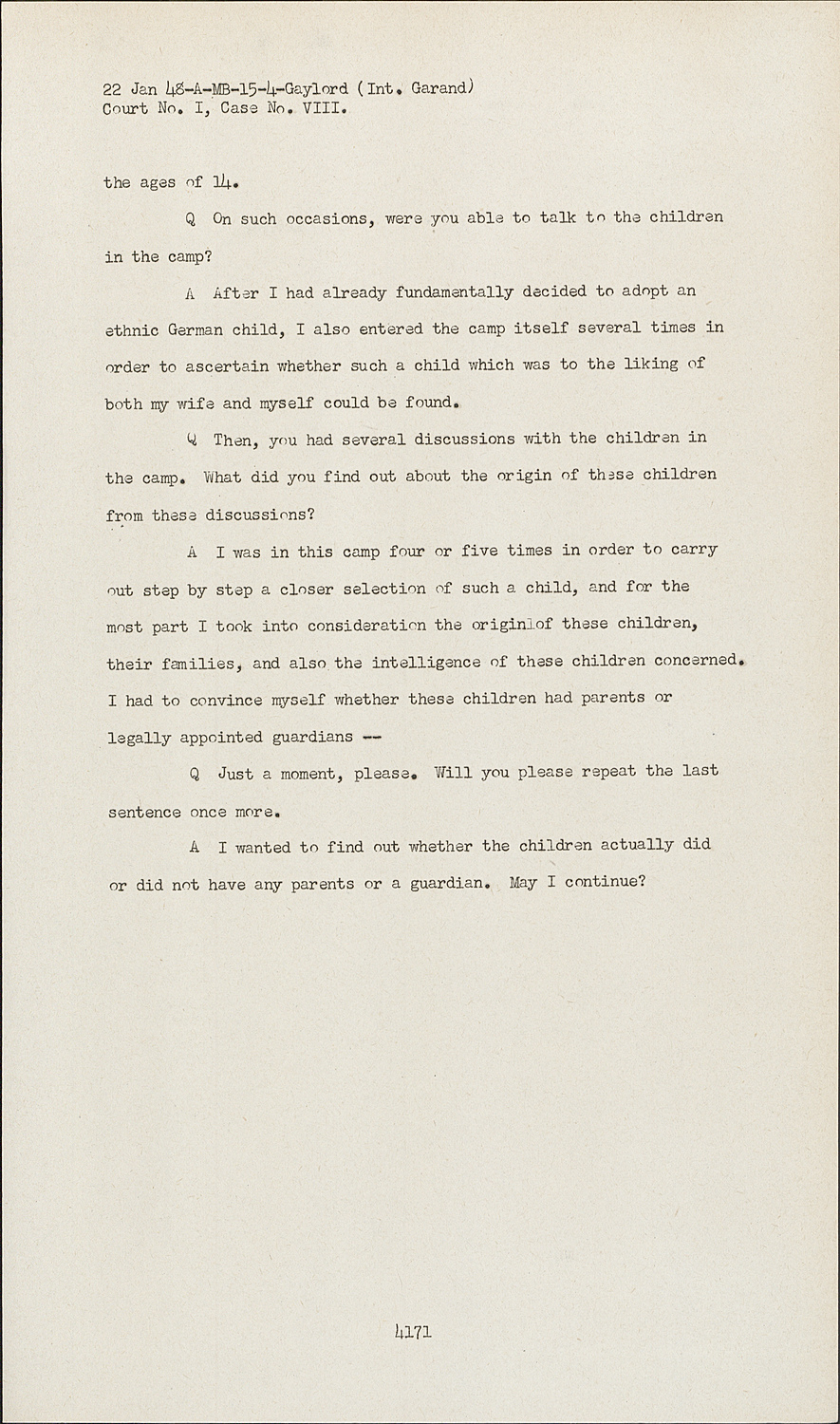
the ages of 14.
QOn such occasions, were you able to talk to the children in the camp?
AAfter I had already fundamentally decided to adopt an ethnic German child, I also entered the camp itself several times in order to ascertain whether such a child which was to the liking of both my wife and myself could be found.
QThen, you had several discussions with the children in the camp. What did you find out about the origin of these children from these discussions?
AI was in this camp four or five times in order to carry out step by step a closer selection of such a child, and for the most part I took into consideration the origin of these children, their families, and also the intelligence of these children concerned. I had to convince myself whether these children had parents or legally appointed guardians -
QJust a moment, please. Will you please repeat the last sentence once more.
AI wanted to find out whether the children actually did or did not have any parents or a guardian. May I continue?
Court No. I, Case No. VIII.
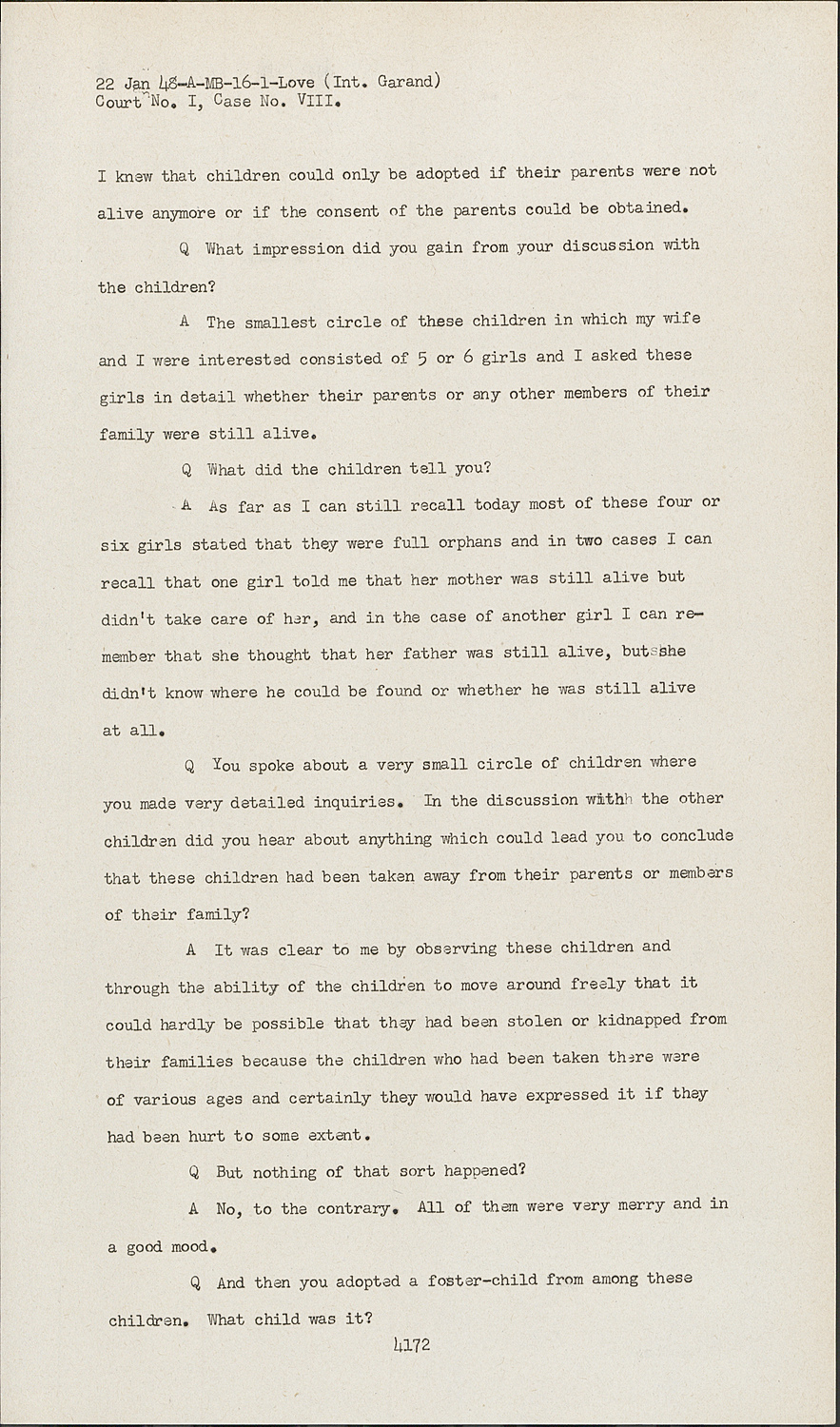
I knew that children could only be adopted if their parents were not alive anymore or if the consent of the parents could be obtained.
QWhat impression did you gain from your discussion with the children?
AThe smallest circle of these children in which my wife and I were interested consisted of 5 or 6 girls and I asked these girls in detail whether their parents or any other members of their family were still alive.
QWhat did the children tell you?
AAs far as I can still recall today most of these four or six girls stated that they were full orphans and in two cases I can recall that one girl told me that her mother was still alive but didn't take care of her, and in the case of another girl I can remember that she thought that her father was still alive, but she didn't know where he could be found or whether he was still alive at all.
QYou spoke about a very small circle of children where you made very detailed inquiries. In the discussion with the other children did you hear about anything which could lead you to conclude that these children had been taken away from their parents or members of their family?
AIt was clear to me by observing these children and through the ability of the children to move around freely that it could hardly be possible that they had been stolen or kidnapped from their families because the children who had been taken there were of various ages and certainly they would have expressed it if they had been hurt to some extent.
QBut nothing of that sort happened?
ANo, to the contrary. All of them were very merry and in a good mood.
QAnd then you adopted a foster-child from among these children. What child was it?
Court No. I, Case No. VIII.
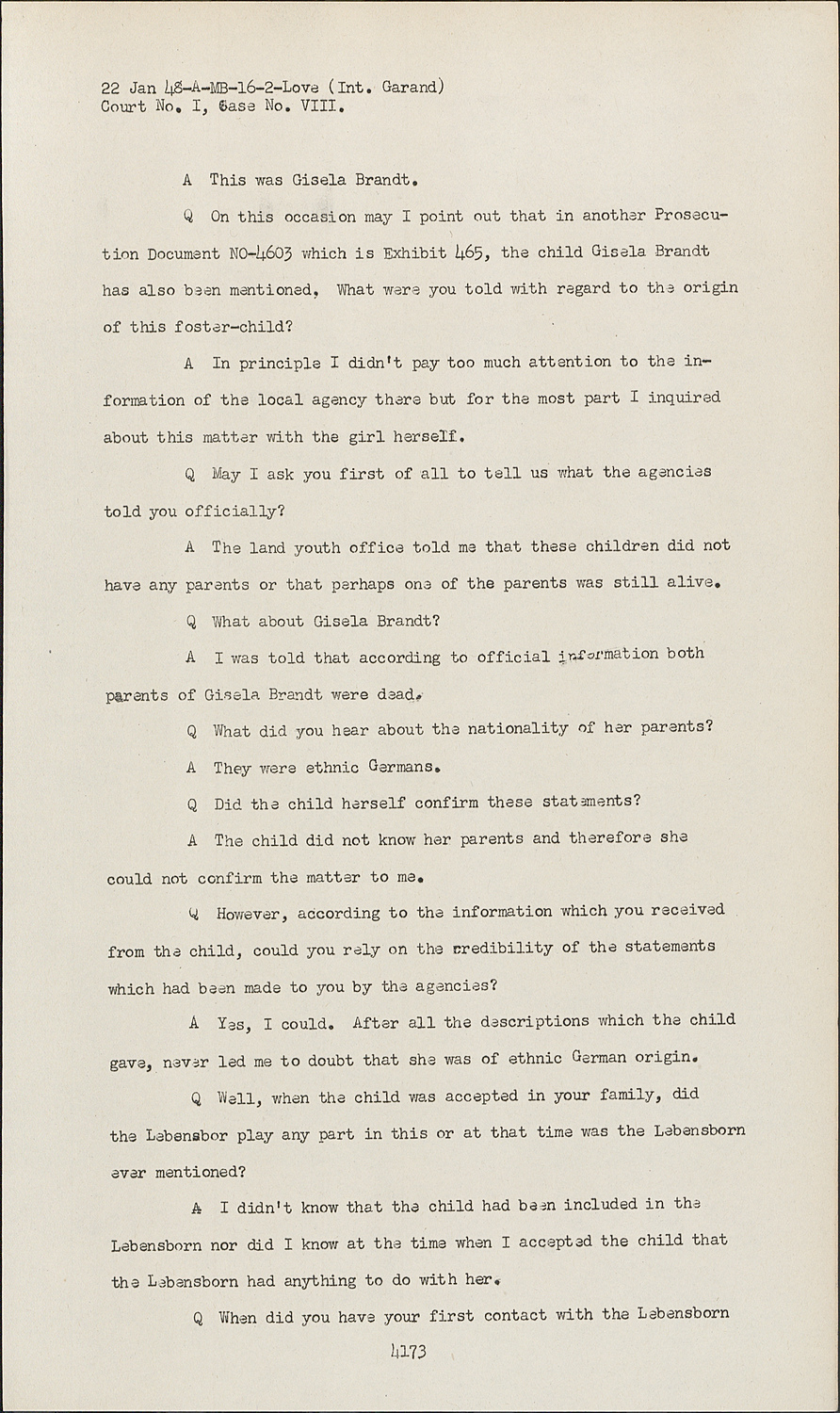
AThis was Gisela Brandt.
QOn this occasion may I point out that in another Prosecution Document NO-4603 which is Exhibit 465, the child Gisela Brandt has also been mentioned. What were you told with regard to the origin of this foster-child?
AIn principle I didn't pay too much attention to the information of the local agency there but for the most part I inquired about this matter with the girl herself.
QMay I ask you first of all to tell us what the agencies told you officially?
AThe land youth office told me that these children did not have any parents or that perhaps one of the parents was still alive.
QWhat about Gisela Brandt?
AI was told that according to official information both parents of Gisela Brandt were dead.
QWhat did you hear about the nationality of her parents?
AThey were ethnic Germans.
QDid the child herself confirm these statements?
AThe child did not know her parents and therefore she could not confirm the matter to me.
QHowever, according to the information which you received from the child, could you rely on the credibility of the statements which had been made to you by the agencies?
AYes, I could. After all the descriptions which the child gave, never led me to doubt that she was of ethnic German origin.
QWell, when the child was accepted in your family, did the Lebensbor play any part in this or at that time was the Lebensborn ever mentioned?
AI didn't know that the child had been included in the Lebensborn nor did I know at the time when I accepted the child that the Lebensborn had anything to do with her.
QWhen did you have your first contact with the Lebensborn Court No. I, Case No. VIII.