It is entered as Prosecution Exhibit 392.
Next is Document NO-3195. It is found on Page 36 of the English and 109 of the German. It is a series of correspondence from the 16th of August to the 14th of December 1943, concerning the age and adoption of the child Hans von Mann. It is hereby entered into evidence as Prosecution Exhibit 393.
Document NO-3019 is found on Page 42 of the English and 116 of the German. It is a letter from Obersteiner to VOMI concerning the deportation of children of Partisans from Oberkrain and Untersteiermark into Germany. It is dated the 14th of September 1943. It is hereby offered into evidence as Prosecution Exhibit No. 394.
Next is Document NO-4819. It is found on Page 45 of the English and 119 of the German. It is an affidavit by Albert Limmer, and is hereby entered into evidence as Prosecution Exhibit 395.
Next is Document No. EC-310. It is found on Page 47 of the English and 122 of the German. It is an order by Himmler, dated the 26th of October 1942 concerning the extermination of Partisans in the East. It is hereby entered into evidence as Prosecution Exhibit No. 396.
Your Honor, the index on the next document was incorrect. If it has not been changed, that should be NO-4173. It is found on Page 48 of the English and 124 of the German. It is a letter from Himmler to Sollman concerning the children of executed members of the Czech resistance movement. It is dated 21 of June 1943, and is hereby entered into evidence as Prosecution Exhibit 397.
Next is a document NO-4171, found on Page 50 of the English and 125 of the German. It is a letter of reply to Himmler from Sollmann concerning the children of executed members of Czech resistance movements.
It is dated 7 of July 1943, and is entered as Prosecution Exhibit 398.
The next document will be omitted, NO-5221.
The next document I would like to offer into evidence is Document NO-435. It is found on Page 56 of the English and 132 of the German. It is dated the 13th of June 1944, and is a letter from Gies to Brandt concerning the seizure of Czech children. It is hereby entered into evidence as Prosecution Exhibit 399.
Next we would like to offer into evidence Document NO-4709. This is an affidavit by Inge Viermetz, and is found on Page 60 of the English and 135 of the German. It is hereby offered into evidence as Prosecution Exhibit 400.
Next is Document NO-5227. It is an affidavit by Meta Hoepfner, and is found on Page 63 of the English and 140 of the German and is entered into evidence as Prosecution Exhibit 401.
DR.VOGEL (for the defendant Sollmann): I request that the affidavit by Meta Hoepfner be only admitted with the reservation that the prosecution should give the opportunity to the defense to call the witness Meta Hoepfner to this courtroom to be cross-examined here.
MR. NEELY:Your Honor, the prosecution will recognize the best evidence rule. Meta Hoepfner is located in the Russian zone. We will, upon request, try to obtain her to testify before this Tribunal, but as we have stated, she is not in the American zone.
THE PRESIDENT:Well, the only thing the Tribunal can do is to say to you that we will be all the help we can to you in getting this witness if you want the witness.
DR.DOETZER (for Dr. Schubert for the defendant Lorenz): Your Honor, the Prosecution, as Exhibit 395, has offered Document No. 4819, an affidavit of Albert Limmer. I also would like to reserve for myself the right, on behalf of the defendant Lorenz, to have Limmer called here as a witness for cross examination.
THE PRESIDENT:Let's get that proposition straightened out now so that there won't be any trouble about it in the future. There is a regular procedure followed both by the prosecution and the defense for the obtaining of witnesses, and that procedure is open to you with reference to any witness at any time, so it won't be necessary to reserve the right. You have the right to make application for any witness you want to.
DR. DOETZER:Your Honor, it is different in other courts. There we had to reserve for ourselves the rights specifically in order to obtain the witness.
THE PRESIDENT:You do not here.
MR. NEELY:Next I would like to offer into evidence Document NO-4460. It is found on Page 67 of the English and 146 of the German. It is a letter from the Main Legal Department of Lebensborn to Ella Spermagel concerning adoption of the child Eva Kubik. It is dated 16 October 1944, and is hereby entered into evidence as Prosecution Exhibit No. 402.
Document NO-4450 is found on Page 69 of the English and 148 of the German. It is an affidavit by Max Sollmann and is entered into evidence as Prosecution Exhibit No. 403.
That concludes Document Book No. VIII-A.
At this time we would like to offer documents found in Document Book NO. VIII-B. The first document found in Document Book VIII-B is Document NO*1680.
It is found on Page 1 of the English as well as Page 1 of the German. It is a directive by Himmler concerning the treatment of children of German men and Polish women and is dated the 6 April 1940; and is hereby entered into evidence as Prosecution Exhibit No. 404.
The next is Document NO. 3188 found on Page 3 of the English as well as 3 of the German. It is a letter dated 18 June 1941 from Himmler to Greiser concerning the collection and placement of selected Polish children. It is hereby entered into evidence as Prosecution Exhibit No. 405.
The next is Document NO-3074. It is found on Page 9 of the English as well as 9 of the German. It is a letter by Creutz to the Reich Statthalter in Wartheland dealing with Germanization of Polish children. It is dated 12 August 1941 and is entered into evidence as Prosecution Exhibit No. 406.
The next is Document No. NO-1615. It is found on Page 11 of the English and 12 of the German. It is Order No. 67/1 signed by Greifelt concerning the Germanization of children from Polish families and Polish orphan homes. It is dated 19 February 1942 and is Prosecution Exhibit No. 407.
Next is Document NO-4704 found on Page 20 of the English and 22 of the German. It is an affidavit by Inge Viermetz and is Prosecution Exhibit No. 408.
Document No. NO-4332, found on Page 23 of the English and 26 of the German Document Book, is a letter to Josef Schwakopf concerning his deportation and the taking away of his children. It is dated the 26 of June, 1942, and is Prosecution Exhibit No. 409.
Document No. NO-3731 is found on Page 25 of the English and 28 of the German. It is correspondence between Hofmann, Rudolf Brandt and Janowsky concerning the care of Polish children eligible to become Germanized. This correspondence is dated the 15 and 17 of April 1942. It is Prosecution Exhibit No. 410.
The next is Document No. NO-5005 found on Page 29 of the English and 33 of the German. It is an affidavit by Rheinhold Grabow. It is Prosecution Exhibit 411.
Document No. NO-1400 is found on Page 31 of the English and 35 of the German. It is dated 13 May 1942 and is a letter from Greifelt to Himmler concerning the seizure and care of children whose parents had been deported. It is Prosecution Exhibit 412.
The next documents which are listed in the document book, which are NO-4896 through NO-4903 inclusive, will be entered into evidence as one exhibit. This correspondence begins on Page 34 of the English and 39 of the German. It is correspondence and file memos concerning the transfer of the Polish child Helena Bukowiecka from her home to the care of Lebensborn. These eight NO numbers are entered as Prosecution Exhibit No. 413.
Document NO-2793, which is found on Page 42 of the English and 47 of the German, is dated 10 December 1942 and is an order signed Bader concerning the installation of a special Police Report Center in the Gau children's home in Kalisz to prevent detection of children by relatives. It is entered into evidence as Prosecution Exhibit No. 414.
Document NO-2798, found on Page 43 of the English and 50 of the German, is a letter from the Reichsstatthalter in Posen, informing the Regierungspraesident in Lodz that Lebensborn is charged by Himmler with carrying out Germanization of Polish orphans. It is dated 23 December 1942 and is entered into evidence as Prosecution Exhibit 415.Document NO-4950, found on Page 46 of the English and 53 of the German, is an affidavit by Klara Keit.
It is entered into evidence as Prosecution Exhibit 416.
Next is Document NO-5229, found on Page 49 of the English and 58 of the German. It is an affidavit by Heinrich Hauser and is entered in evidence as Prosecution Exhibit No. 417.
Document No. NO-2678, found on Page 55 of the English and 70 of the German is a letter by Dr. Arlt inquiring as to the care of foreign minors. It is dated 10 March 1943 and is entered into evidence as Prosecution Exhibit No. 418.
Document No. 1126, found on Page 57 of the English and 71 of the German is a memo dated 10 March, 1943, signed Harders, concerning the conference dealing with treatment of illegitimate children of Polish race. It is entered into evidence as Prosecution Exhibit No. 419.
DR. SCHWARZ:Dr. Schwarz for the defendant Hofmann. May it please the Tribunal, I do not want to object to this document, but in order to affirm the probative value of that document I would like to point out that in the face of this document this is not the official transcript of a meeting; but it is only a file note of one member who participated in the meeting. I would like you to give due consideration to that fact.
THE PRESIDENT:May the Tribunal suggest to counsel that in the first place, the Tribunal will give to this document and all other documents, only such probative value as in the opinion of the Court it is entitled to have. I state further that now is not the time to argue those questions. When you come to make your argument to the Tribunal that would be the proper time to point those things out and would be more helpful to the Tribunal.
MR. NEELY:Document No. NO-4335 is found on Page 62 of the English and 76 of the German. It is a letter from RuSHA concerning the Germanization of two Polish children and is dated 16 March, 1943. It is hereby entered into evidence as Prosecution Exhibit No. 420.There has also been a correction made on the next document as found in the index.
The next document is Document No. NO-4946. It is found on Page 63 of the English and 77 of the German. It is a letter from the Welfare Office Litzmannstadt concerning the forcible removal of two Polish children. It is hereby entered into evidence as Prosecution Exhibit No. 421.
Next is document No. NO-4935. It is found on page 65 of the English and 79 of the German. It is a letter from the SIPO to the Youth Office stating that the parents and brother of the two children Zjadel have been taken to concentration camps for refusal to be listed on the SVL. It is Prosecution Exhibit No. 422.
Next is document No. NO-2677 and is found on page 66 of the English and 80 of the German. It is a letter dated 28th of April 1943 concerning the Germanization of Polish children and is signed Dr. Arlt and is entered into evidence as Prosecution Exhibit No. 423.
Document No. NO-4706 is an affidavit by Max Sollmann. It is found on page 68 of the English and 82 of the German. It is Prosecution Exhibit No. 424.
Document No. NO-1371, found on page 71 of the English and 86 of the German is a letter informing Ebner of a conference concerning the changing of names of children from Polish to German. It is dated 16 July 1943 and is entered into evidence as Prosecution Exhibit No. 425.
Document No. NO 4978 found on page 73 of the English and 89 of the German is an affidavit by Franziska Ranzinger. It is Prosecution Exhibit No. 426.
Document No. NO 2871 found on page 76 of the English and 95 of the German. It is correspondence among Ebner, Tesch, and Mrs. Ilse Braeuer concerning the probable age of the child Hedwig Paczkowska. It is Prosecution Exhibit No. 427.
Document No. NO-1369 is found on page 80 of the English and 99 of the German. It is a letter dated 2 August 1943. It is a letter from V. Wenzen requesting Ebner to make out a birth certificate for the child Alexander Claus. It is entered into evidence as Prosecution Exhibit No. 428.
Document No. NO-5228 is found on page 81 of the English COURT I CASE VIII and 100 of the German Document Book.
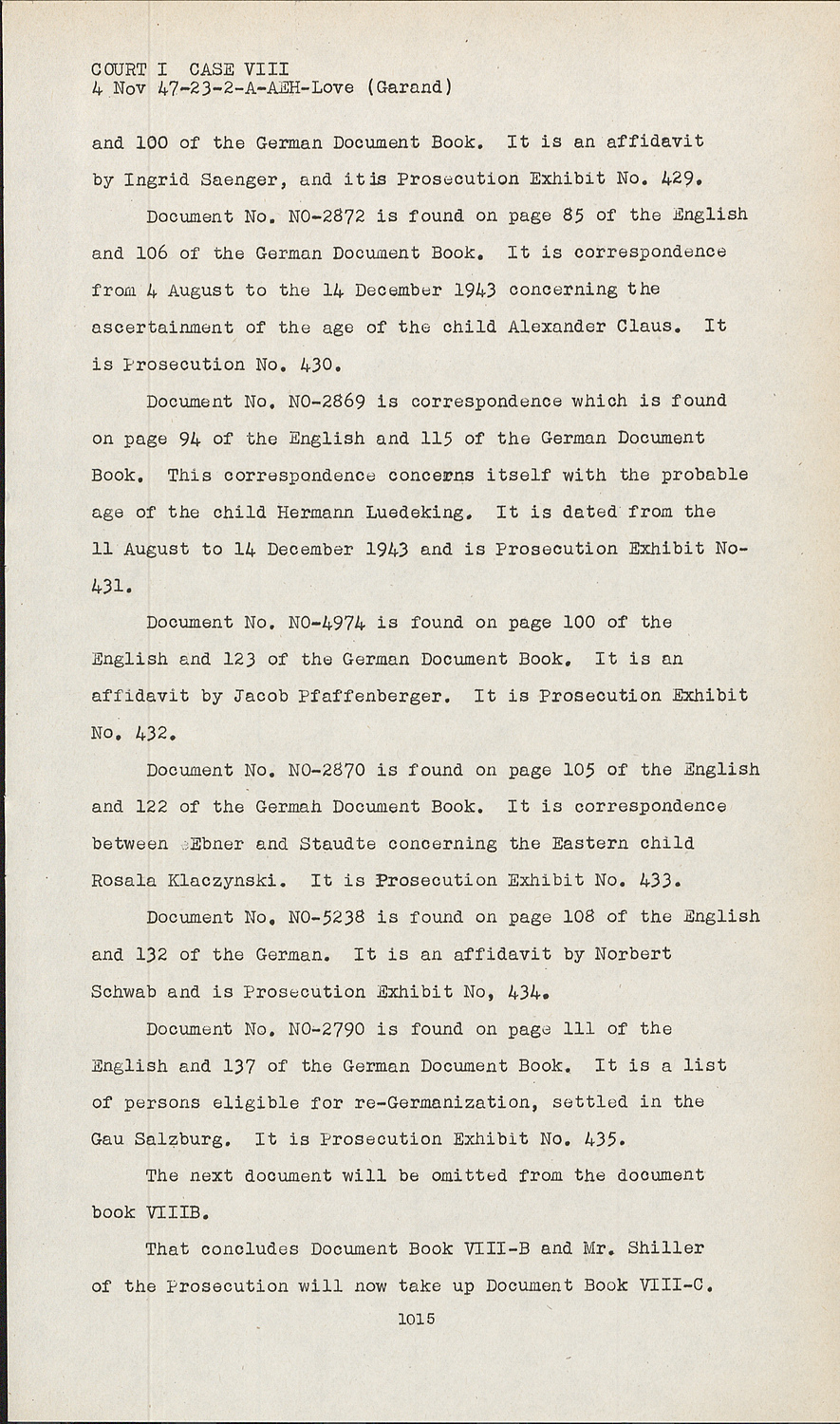
It is an affidavit by Ingrid Saenger, and it is Prosecution Exhibit No. 429.
Document No. NO-2872 is found on page 85 of the English and 106 of the German Document Book. It is correspondence from 4 August to the 14 December 1943 concerning the ascertainment of the age of the child Alexander Claus. It is Prosecution No. 430.
Document No. NO-2869 is correspondence which is found on page 94 of the English and 115 of the German Document Book. This correspondence concerns itself with the probable age of the child Hermann Luedeking. It is dated from the 11 August to 14 December 1943 and is Prosecution Exhibit No431.
Document No. NO-4974 is found on page 100 of the English and 123 of the German Document Book. It is an affidavit by Jacob Pfaffenberger. It is Prosecution Exhibit No. 432.
Document No. NO-2870 is found on page 105 of the English and 122 of the German Document Book. It is correspondence between Ebner and Staudte concerning the Eastern child Rosala Klaczynski. It is Prosecution Exhibit No. 433.
Document No. NO-5238 is found on page 108 of the English and 132 of the German. It is an affidavit by Norbert Schwab and is Prosecution Exhibit No, 434.
Document No. NO-2790 is found on page 111 of the English and 137 of the German Document Book. It is a list of persons eligible for re-Germanization, settled in the Gau Salzburg. It is Prosecution Exhibit No. 435.
The next document will be omitted from the document book VIIIB.
That concludes Document Book VIII-B and Mr. Shiller of the Prosecution will now take up Document Book VIII-C.
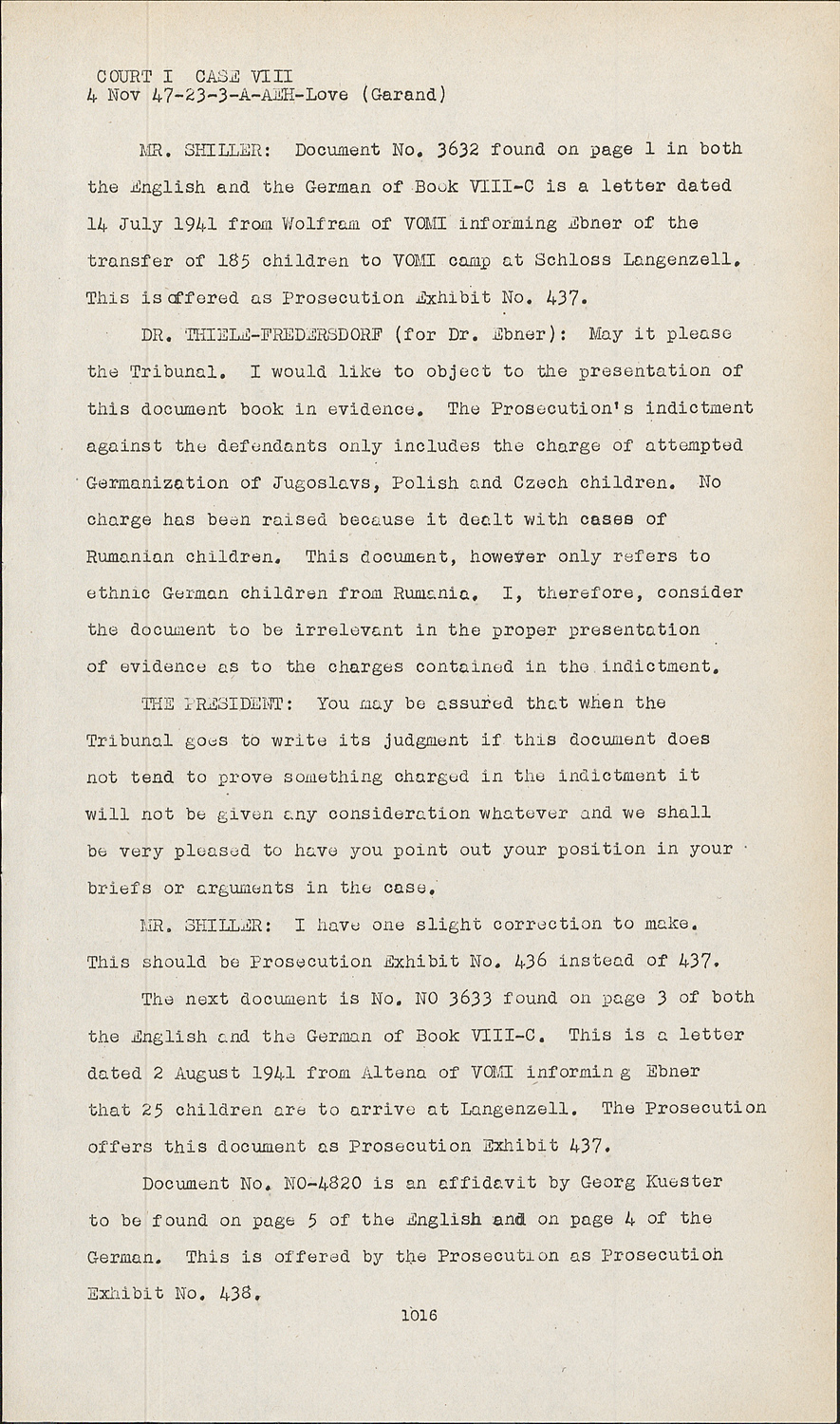
MR. SHILLER:Document No. 3632 found on page 1 in both the English and the German of Book VIII-C is a letter dated 14 July 1941 from Wolfram of VOMI informing Ebner of the transfer of 185 children to VOMI camp at Schloss Langenzell. This is offered as Prosecution Exhibit No. 437.
DR.THIELE-FREDERSDORF (for Dr. Ebner): May it please the Tribunal. I would like to object to the presentation of this document book in evidence. The Prosecution's indictment against the defendants only includes the charge of attempted Germanization of Jugoslavs, Polish and Czech children. No charge has been raised because it dealt with cases of Rumanian children. This document, however only refers to ethnic German children from Rumania. I, therefore, consider the document to be irrelevant in the proper presentation of evidence as to the charges contained in the indictment.
THE PRESIDENT:You may be assured that when the Tribunal goes to write its judgment if this document does not tend to prove something charged in the indictment it will not be given any consideration whatever and we shall be very pleased to have you point out your position in your briefs or arguments in the case.
MR. SHILLER:I have one slight correction to make. This should be Prosecution Exhibit No. 436 instead of 437.
The next document is No. NO 3633 found on page 3 of both the English and the German of Book VIII-C. This is a letter dated 2 August 1941 from Altena of VOMI informing Ebner that 25 children are to arrive at Langenzell. The Prosecution offers this document as Prosecution Exhibit 437.
Document No. NO-4820 is an affidavit by Georg Kuester to be found on page 5 of the English and on page 4 of the German. This is offered by the Prosecution as Prosecution Exhibit No. 438.
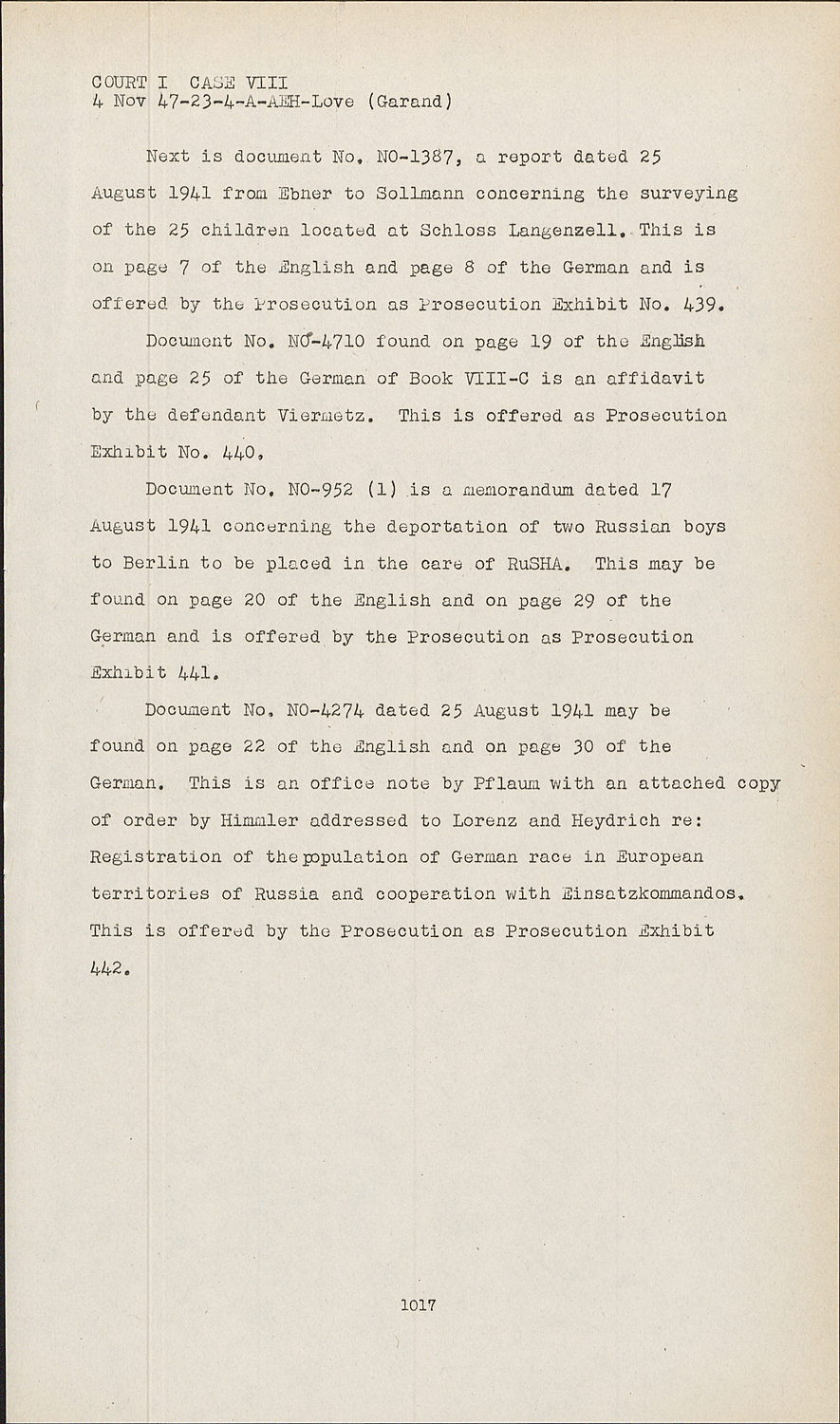
Next is document No. NO-1387, a report dated 25 August 1941 from Ebner to Sollmann concerning the surveying of the 25 children located at Schloss Langenzell. This is on page 7 of the English and page 8 of the German and is offered by the Prosecution as Prosecution Exhibit No. 439.
Document No. NO-4710 found on page 19 of the English and page 25 of the German of Book VIII-C is an affidavit by the defendant Viermetz. This is offered as Prosecution Exhibit No. 440.
Document No. NO-952 (1) is a memorandum dated 17 August 1941 concerning the deportation of two Russian boys to Berlin to be placed in the care of RuSHA. This may be found on page 20 of the English and on page 29 of the German and is offered by the Prosecution as Prosecution Exhibit 441.
Document No. NO-4274 dated 25 August 1941 may be found on page 22 of the English and on page 30 of the German. This is an office note by Pflaum with an attached copy of order by Himmler addressed to Lorenz and Heydrich re: Registration of the population of German race in European territories of Russia and cooperation with Einsatzkommandos. This is offered by the Prosecution as Prosecution Exhibit 442.
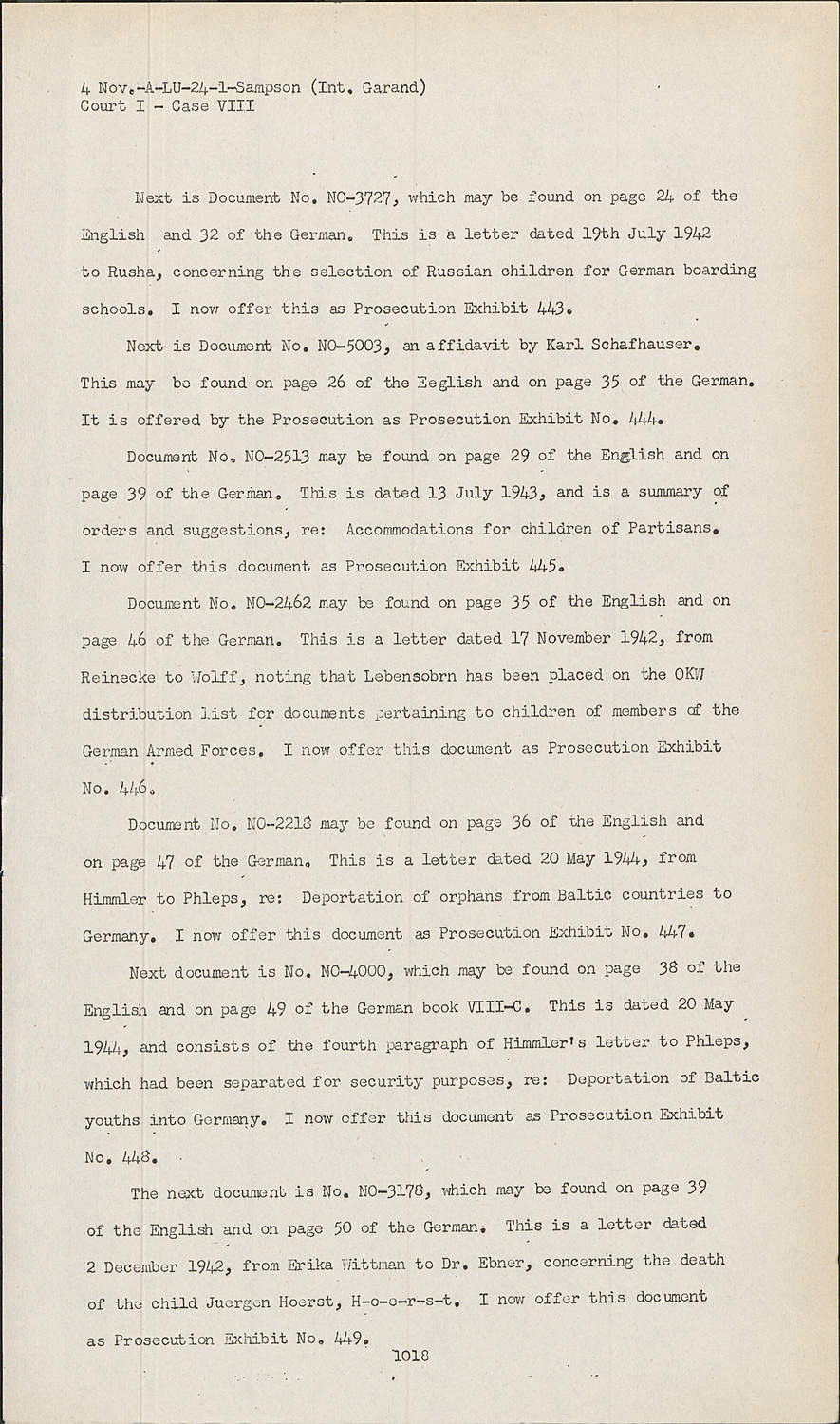
Next is Document No. NO-3727, which may be found on page 24 of the English and 32 of the German. This is a letter dated 19th July 1942 to Rusha, concerning the selection of Russian children for German boarding schools. I now offer this as Prosecution Exhibit 443.
Next is Document No. NO-5003, an affidavit by Karl Schafhauser. This may be found on page 26 of the Eeglish and on page 35 of the German. It is offered by the Prosecution as Prosecution Exhibit No. 444.
Document No. NO-2513 may be found on page 29 of the English and on page 39 of the German. This is dated 13 July 1943, and is a summary of orders and suggestions, re: Accommodations for children of Partisans. I now offer this document as Prosecution Exhibit 445.
Document No. NO-2462 may be found on page 35 of the English and on page 46 of the German. This is a letter dated 17 November 1942, from Reinecke to Wolff, noting that Lebensobrn has been placed on the OKW distribution list for documents pertaining to children of members of the German Armed Forces. I now offer this document as Prosecution Exhibit No. 446.
Document No. NO-2218 may be found on page 36 of the English and on page 47 of the German. This is a letter dated 20 May 1944, from Himmler to Phleps, re: Deportation of orphans from Baltic countries to Germany. I now offer this document as Prosecution Exhibit No. 447.
Next document is No. NO-4000, which may be found on page 38 of the English and on page 49 of the German book VIII-C. This is dated 20 May 1944, and consists of the fourth paragraph of Himmler's letter to Phleps, which had been separated for security purposes, re: Deportation of Baltic youths into Germany. I now offer this document as Prosecution Exhibit No. 448.
The next document is No. NO-3178, which may be found on page 39 of the English and on page 50 of the German. This is a letter dated 2 December 1942, from Erika Wittman to Dr. Ebner, concerning the death of the child Juergen Hoerst, H-o-e-r-s-t. I now offer this document as Prosecution Exhibit No. 449.
The next document is NO-4837. This may be found on page 40 of the English and on page 51 of the German. It is a letter dated 20 May 1940, from Sollmann to Ebner, concerning the transfer of pregnant Norwegian women into the Reich. I now offer this document as Prosecution Exhibit No. 450.
Next is Document No. NO-4836. This may be found on page 42 of the English and on page 53 of the German. It is a letter dated 22 May 1940, from Ebner to Sollmann, suggesting that Labensborn care of Norwegian children and mothers transferred into the Reich. I now offer this document as Prosecution Exhibit No. 451.
Next is Document No. NO-2916; this may be found on page 44 of the English and on page 56 of the German. It is a letter dated 4 January 1943, to Meine, transmitting a draft report on the welfare of the children of Germans in Norway, and is signed by a Lebensborn official. I now offer this document as Prosecution Exhibit No. 452.
Document No. NO-3175 may be found on page 47 of the English and on page 59 of the German. This is a telegram dated 21 February, 1943, from Tiedgen to Sollmann, concerning the transportation of children. I now offer this document as Prosecution Exhibit No. 453.
Next is Document No. NO-3186. This may be found on page 49 of the English and on page 60 of the German. It is a letter dated 11 March 1943, from Dr. Feith to Ebner, concerning the arrival of Norwegian children in Sonnenwiese. I now offer this document as Prosecution Exhibit No. 454.
Document No. NO-4609, which may be found on page 51 of the English and on page 61 of the German, is a letter dated 14 March 1944, from the Munich branch of the Berliner Verein, an Insurance Company, concerning an additional list of Norwegian children to be insured which have been received from Lebensborn. I now offer this document as Prosecution Exhibit No. 455.
Document No. NO-3185 may be found on page 52 of the English and on page 62 of the German. This is a letter dated 30 March, 1943, from Dr. Feith to Dr. Ebner, concerning the health of the children at Sonnenwiese.
I now offer this document as Prosecution Exhibit No. 456.
Next is Document No. NO-4608. This may be found on page 54 of the English and on page 65 of the German. It is a letter dated 8 February 1944, from Lenner, L-e-n-n-e-r; that is incorrectly spelled Lennard in the index of the English; to the Berliner Verein concerning acceptance of children of other areas into the group F Insurance Plan "Eastern Children." I now offer this document as Prosecution Exhibit No. 457.
Document No. NO-4973 is an affidavit by Adolf F-o-e-h-l, which may be found on page 55 of the English and on page 67 of the German. I now offer this affidavit as Prosecution Exhibit No. 458.
Document No. NO-1390 may be found on page 58 of the English and on page 70 of the German. This is correspondence dated 15th October, 1943, 25 May -- it should be 1944 -- in the English, and 30 May, 1944. This correspondence concerns illegitimate children of the German occupation forces on the Channel Islands. I now offer this document as Prosecution Exhibit No. 459.
Document No. NO-3218 may be found on page 61 of the English and on page 73 of the German. This is a letter dated 24 May 1944, from Zwickler to the Chief of RuSHA, concerning the deportation of children from the Channel Islands. I now offer this document as Prosecution Exhibit No. 460.
Next is Document No. NO-929. This may be found on page 63 of the English and on page 75 of the German. It is a letter dated 24 May, 1944, from Zwickler to Turner, concerning illegitimate children of members of the German occupation forces. I now offer this document as Prosecution Exhibit No. 461.
Next is Document No. NO-3217. This may be found on page 65 of the English and on page 77 of the German. It is a letter dated 8 June, 1944, from Zwickler to Klinger concerning the settlement of Yvonne Schwalm. I now offer this document as Prosecution Exhibit No. 462.
Next is Document PS-031. This may be found on page 67 of the English and on page 79 of the German.
It is dated June, 1944, and is an inner-office report to Rosenberg concerning the deportation of foreign juveniles from occupied territories. I now offer this document as Prosecution Exhibit No. 463.
Next is Document No. NO-4604. This may be found on page 70 of the English and on page 84 of the German. This document is undated; it is a list of children placed into foster homes, found in the files of the Berliner Verein, Insurance Company. I now offer this document as Prosecution Exhibit No. 464.
Next are three NO numbers which should be considered as one document. These are document numbers NO-4601, 4602 and 4603. These documents begin on page 76 of the English and on page 91 of the German. The Prosecution wishes to offer these three as one exhibit. These documents, to begin with, are a coverletter dated 1 December, 1944 from The Berliner Verein to the Legal Office of Lebensborn, with an attached list of children who have left the Group Insurance and also the names of those still remaining with the Group Insurance of eastern children. The Prosecution offers these three documents together as Prosecution Exhibit No. 465.
That concludes Document Book VIII-C.
THE PRESIDENT:The Tribunal will recess until 9:30 tomorrow morning.
(The Tribunal adjourned until 5 November 1947, at 0930 hours.)
Official Transcript of the American Military Tribunal No. I, in the matter of the United States of America against Ulrich Greifelt, et al, defendants sitting at Nurnberg, Germany, on 5 November 1947, 0930-1630, Justice Wyatt, Presiding.
THE MARSHAL:The Honorable, the Judges of Military Tribunal I. Military Tribunal I is now in session. God save the United States of America and this Honorable Tribunal.
There will be order in the court.
THE PRESIDENT:Military Tribunal I will come to order. Mr. Marshal, have you ascertained that all defendants are present in court?
THE MARSHAL:May it please your Honor all defendants are present in the court room.
THE PRESIDENT:The record will so indicate. Proceed with the Prosecution.
MR. LAMB:May it please the Tribunal, the Prosecution would like to call as its next witness Dr. Zygmunt Klukowski. The native tongue of the witness is Polish and we have arranged to have a Polish interpreter sit with him. She is a civil service employee and is taking the oath.
THE PRESIDENT:Have you ascertained the oath to be administered to the witness?
MR. LAMB:Yes, sir.
THE PRESIDENT:German?
MR. LAMB:The oath is in Polish; she will interpret the oath. It is the same oath that you have administered to the German witnesses.
DR. ZYGMUNTKLUKOWSKI; a witness, took the stand and testified as follows: BY THE PRESIDENT:
Q.The witness will raise his right hand and repeat after me:
I swear by God.
A.I swear by God.
Q.The Almighty and Omniscient.
A.The Almighty and Omniscient.
Q.That I will speak the pure truth.
A.That I will speak the pure truth.
Q.And will withhold and add nothing.
A.And will withhold and add nothing. BY MR. LAMB:
DIRECT EXAMINATION
Q.Will the witness please state his name.
A.Zygmunt Klukowski.
Q.What is your nationality?
A.Polish.
Q.Where do you reside?
A.In the District of Zamosz, in the little town of Sebrsebrzeszyn.
Q.Is that in Poland?
A.In Poland.
Q.For how long have you lived there?
A. 28 years.
Q.What is your profession?
A.Medical doctor.
Q.What position did you occupy prior to the war?
A.A director of a hospital.
Q.Did you occupy this position when the Germans invaded Poland?
A.Yes.
Q.Did you continue to occupy this position during the occupation of Poland by Germany?
A.During all this time I had the same position.
Q.Is the Zamosz area in what was known to the Germans during their occupation as the Government General?
A.Yes, so it is.
Q.After the German occupation of this area in the town in which you lived did you personally witness forced evictions and resettlement of the areas evicted?
A.Yes, so it is.
Q.Did you in addition to what you witnessed personally make a study of the evacuations or evictions and resettlement of the Zamosz area. I didn't get the answer to that.
A.The evictions started in 1942.
Q.Wait just a minute now. The question was: Has he made a study of the evictions or evacuations that were made in that area?
A.Yes, so it is, very thoroughly.
Q.As a result of these studies and investigations have you written any books about this project?
A.Yes, so it is; I have written books.
Q.How many books has he written on this subject?
A.Five books.
Q.Were any of these books written under the auspices of the Polish government?
A.Four books I wrote on my own initiative and the fifth I was requested to write at the request of the Polish government as specialist on the problem of evictions.
Q.Will you please give the title of the books that you have written on this subject?
A.The books have been edited for a history of events in the Zamosz area in the war years 1939 until 1945 and edited by Dr. Zygmunt Klukowski
Q.Will you please state what happened with reference to evictions after the Germans had occupied this area which included the town in which you lived?
A.Do you want to know how my special district was affected?
Q.That's right.
A.In the place where I lived eviction took place in 1943 at two different periods.
Court No. I, Case No. VIII.
Q.Could you tell me how many villages in this area of Zamosz were evacuated?
A.In the whole of the Zamosz area in all the four districts 297 villages, were evicted.
Q.What is the area of this area in square kilometers?
A.Well the size in square kilometers of the whole area is 607,000 square kilometers.
Q.How many villages were in this area?
A. 691 villages.
Q.About half of these you stated were evacuated?
A.Yes, so it was, nearly half.
Q.Will you please describe to the Tribunal the methods which were used in evacuating these villages?
A.It usually started in this manner: During the night the whole village was surrounded by surprise and all the houses were entered into and the whole population was driven out to some square in the middle of the village. From 15 to 20 minutes were given to leave the dwellings. It was not allowed to take along anything, only very little food. The people were driven out of their houses. Those who objected were kicked with the foot, beaten with clubs and with butts of rifles and sometimes they were driven by dogs. Sick people who couldn't move themselves were asked to be carried out and in some instances those who objected or very old people who didn't want to leave their homes were shot on the spot. After everybody had been driven away on the square they were held for several, sometimes many, hours. It didn't matter whether it was winter or summer. Children who were very poorly clad suffered most thereby. It often happened that small children at their mother's breast after many hours standing in the snow froze to death; while the rest were standing on the square a selection was carried out.
People were chosen about 10 to 20 who stayed behind as farm hands. They were going to be farm hands to those people who were going to be resettled, newcomers. All workers who were occupied in construction of the airport, stayed behind. During such an eviction usually very much was looted. When all had gone out together on the square they were taken to a camp, a transient camp in Zverinec. After arriving at the camp they were all taken before a Commission and there they were segregated and distributed over several groups, or rather allocated to several groups. There were several groups. These people who were considered of Nordic or Germanic race was the first group. The second group were those people with certain German traces of Germanic traits which could be discovered. Those two groups received special treatment and they were sent to Germany in order to be Germanized completely. The third group were those, everybody from 14 years onward to 60 years, who were able to work. People from this group were sent to work to Germany. The first group were old people, sick people, invalids, children up to 14, and everybody who was not fit to work. All these people were sent to districts surrounding Warsaw. There we were distributed in different settlements which were called Rentendoerfer, which were called pension villages and sometimes they were also given houses which had been left by the Jews. Apart from that, from the third group, people were chosen particularly, sometimes whole families, who were suspected and they were sent to concentration camps in Majdanek or Auschwitz. After such a commission took place every family was divided up and the children were always separated from their parents. If the parents refused to give up their children then the children as well as the parents were beaten. After they all had been divided they were put into different huts and the parents were not allowed to see their children any longer.