Court No. I, Case No. VIII.
I only heard once that an office should be established there. I believe it was the office of the Military Commander, to which later on some people of the VOMI were attached. I don't know the details.
QThank you. Do you know about the activity of Brueckner as head of Office-VI?
AI know Brueckner's activity as head of the advising Office for immigrants, and his work there was to look after the Ethnic Germans living in the Reich.
QDo you know why was Brueckner given this task?
AThis task was mainly concerned with welfare work and Brueckner seemed to be suitable for this task.
DR. FOETZFR:Thank you very much, witness, I have no further questions.
DIRECT EXAMINATION BY DR. MERKEL: (For the defendant Creutz.)
QHerr Dr. Kubitz, do you know the defendant Creutz?
AYes.
QFrom what time on was Creutz the deputy of the defendant Greifelt as chief of the Main Staff Office?
AI know Fehndrich as deputy for Greifelt. Later on I heard after Fehndrich had left that Creutz was supposed to be the deputy of Greifelt.
QWhen did Fehndrich leave?
AAs far as I remember in 1942.
QDo you know any more details, Spring, Summer or Autumn, 1942?
AI should say during the first half of 1942, but this date is indefinite, because I was not concerned with the Reichskommissariat.
QHow do you know then that Fehndrich during the first half of 1942 was the deputy of Greifelt?
AFehndrich was present at meetings of the Main Staff Office as deputy of Greifelt. He identified himself as such, and so did Greifelt. I should say that it was known in all Berlin offices that Court No. I, Case No. VIII.
Fehndrich acted as deputy for Greifelt.
QIn your testimony you repeatedly mentioned Behrens. Do you know that especially Behrens negotiated with Fehndrich?
AYes, I have often seen that Fehndrich came to Behrens, and on principle Behrens received only the staff leaders, or the chiefs themselves. He didn't concern himself with the referents.
DR. MERKEL:Thank you, I have no further questions.
THE PRESIDENT:You may proceed with the cross examination.
CROSS EXAMINATION BY MR. SHILLER:
QWitness, after Behrens left VOMI, did any one take his place in practice, if not in title as deputy of Lorenz?
AI am sorry I can not give any information about this, because I left the office together with Behrens to join the army. afterwards I never had any more connection with VOMI.
QIn other words, witness, you claim that you know nothing about VOMI after the middle of 1943, is that correct?
AYes.
QWitness, do you know who paid the personnel under Hoffmeier in the East?
AI can not say. I had nothing to do with these things. I would assume that it was paid by whatever office these people belonged to as war workers; but that is an assumption on my part, because I took no interest in that.
QWitness, on direct examination you stated that you were never in the so-called Hauptamt VOMI, is that correct?
AYes, that is right. I was a member of the old VOMI and not of the VOMI Main Office.
QWitness, weren't you at one time the head of Office-IX?
AI was not head of Office-IX, but in the spring of 1943 the reorganizing of VOMI was getting under way, and at the time I was to get the office for political leadership of the German Ethnics, which Court No. I, Case No. VIII.
later developed into Office-IX. This office consisted of myself and two other workers.
QYou were in charge of this office at one time, is that correct?
AWhen you say "chief", I don't know, but if that is the same thing as a departmental chief, yes.
QI don't want to quibble about a title, witness. Were you actually in charge of this Office-IX?
AYes.
QWitness, how do you explain the fact that this Office-IX is included in the table of organization of the Hauptamt VOMI?
AI don't know the organizational plan of VOMI Main Office, nor can I explain how that fits in there, because in my days there was a distinction between the old VOMI and the VOMI Main Office. There were two letter heads. The letterheads which I used, and which the other departmental chiefs of Old VOMI used, were always the letterhead of VOMI, whereas the resettlement people, that is, people of the actual Main Office always used the letterhead "Reich Commissioner for the strengthening of German Volkdom, Main Office VOMI". This letterhead I was not entitled to use.
QWitness, did you ever hear of Ethnic Germans being forced into the German Armed Forces without benefit of a treaty?
ANo, I never heard of that. All the Ethnic Germans who were drafted into the Waffen-SS, of which I knew were on the basis of an agreement with the countries concerned, I would not call it drafted, but accepted by the Waffen-SS on the basis of their voluntary application.
QWitness, you stated on direct examination that both you and Lorenz were anxious to have a law passed to make it legal to put these Ethnic Germans placed into the German Armed forces. What did you have in mind as being illegal?
AWhat I had in mind as being illegal was to draft those Court No. I, Case No. VIII.
Ethnic Germans who outside of state treaties had volunteered for the Waffen-SS, and who might have been drafted without the knowledge of their own country. I mentioned an example of General Phleps yesterday, who in actual fact had done something not quite permissible under International law, and just because of this Lorenz had gone to see Himmler to prevent a similar occurrence in the future, and to set right the results of such actions, so that in actual fact the people who had been drafted in violation of International law were returned. We had in mind that if the Waffen-SS wanted Germans from any country where there were Ethnic Germans, then the replacement unit of the Waffen-SS was to get in touch with the foreign office so that the foreign office could negotiate with the foreign country. If the foreign country refused to conclude an agreement, then the men would not be drafted into the Waffen-SS. If the foreign country was prepared to forego its claim on the service of these men, and prepared to let them go into the Waffen-SS in Germany, then the men could join and then everything would be OK. This principle and the maintenance of International Agreements was what Lorenz and I had in mind at the time.
QWitness, in this case you just mentioned of General Phleps of the Prinz Eugene Division, you did hear of Ethnic Germans being drafted without benefit of treaty, is that correct?
AThey were not drafted. They had volunteered, and I didn't hear beforehand that they were to be drafted. I was faced with the fact and we were trying to annull this and to restore the principle of International Law.
QWitness, I am afraid some of our difficulty may be due to the translation of the words "drafting" and "volunteering" being used a little bit loosely. Now in this case you said first they had volunteered and then that you had heard about the men being drafted. Now ware all these men in the Prinz Eugen Division, concerning which you were talking, were they drafted, or did they volunteer?
Court No. I, Case No. VIII.
AI will make my statement absolutely clear. The men from abroad, Rumania and Croatia had volunteered.
QPardon me, witness, I have asked a specific question. Please answer the question with respect to the men in the Prinz Eugen Division with General Phleps, the ones concerning whom you spoke before. It is not necessary to go into Rumania and other countries.
AYes, that is what I am talking about. In the Prinz Eugen Division originally only men from the Serbian Banate were to be in included, volunteers, and in addition Phleps included men who had volunteered from Roumania and Croatia, and also conscripted men from the Serbian Banate, and when we heard that we saw to it that the International Law principle was restored, and Phleps had to discharge the non-volunteers from the Serbian Banate, 4000 men, and also had to discharge and send home those Ethnic Germans from Rumania and Croatia who had volunteered.
QWitness, I still have not got a clear answer. Were any of these men drafted, or were they all volunteers?
AThe larger part of the men of the Prinz Eugen Division volunteered, but some of them had not volunteered, and these Phleps had to give back, who had been drafted had to be sent back.
QThank you, that is what I am trying to find out. Witness, why did Behrens ask Brueckner to negotiate with the foreign office?
AHimmler didn't like it, if agencies subordinate to him refused to obey his orders, especially in cases of resettlemtn. So, we had rather got into the habit at VOMI of looking around for some other agency, mainly the foreign office, with which we could go hand in hand, and as Himmler had a certain respect for the foreign office, because he didn't want to get into trouble with Ribbentrop, they were usually successful in getting what we wanted.
QPardon me, my question really is, why did Behrens pick Brueckner for this job?
ABrueckner seemed a suitable person because he was on his Court No. I, Case No. VIII.
own accord and without instructions opposed to any of Himmler's resettlement spleens, and he was, therefore, in a good position to explain to the Foreign Office the objection of VOMI.
MR. SHILLER:The prosecution has no further questions. Your Honor.
REDIRECT EXAMINATION BY DR. SCHUBERT:
QWitness, you ware asked about the connection of Office-IX to VOMI Main Office. An organizational plan has been submitted as Exhibit No. 36, this organizational plan is dated 15 June 1944. Were you still in the VOMI at the time?
ANo.
QIn the organizational plan all the offices from one to eleven are included. Is it correct that in this organizational plan the old VOMI as well as the VOMI Main Office are put together in one plan?
AYes.
QOne final question, with reference to these draftings by General Phleps. Did VOMI leave anything in advance about this drafting, or during that time, hear anything about this drafting, or did VOMI in any way have any connection with the General Phlep's drafting?
AVOMI had no concern with the drafting, and it was only when Ethnic group leader Janko advised VOMI that VOMI considered it her duty to restore conditions in keeping with International Law. If I may put it that way -- VOMI was only called in after the damage had been done. That is right.
QThank you.
EXAMINATION BY DR. DOETZER:
QWitness, on cross examination, if I understood you correctly, you said that Brueckner on his own accord was opposed to all deportations, and especially Himmler's resettlement spleen, is that correct?
Court No. I, Case No. VIII.
AYes.
QWere you the only person who knew that or was that generally known?
AThat was generally known.
QDid Brueckner have any disadvantages because of that, was he attacked, were reports written against him, or did the Reichs fuehrer-SS and the RSHA simply accept this state of affairs?
ABehrens had called me in one day and showed me a letter from the Reich Security Main Office in which the RSHA reported that Brueckner always showed a "stubborn attitude" towards resettlement and other wishes of Himmler. The letter said because of his attitude Brueckner was unsuitable. It also was added therein that he had lost his job once before on the basis of the civil servants law, and was hardly suitable to remain in the VOMI. So far as I am informed, however, Behrens had always shared Brueckner's view, and, therefore, didn't do anything or rather prevented the RSHA from doing anything.
DR. DOETZER:Thank you. I have no further questions.
THE PRESIDENT:The witness will be excused.
(Witness excused)
DR. SCHUBERT:The next witness I'll call is Herr Konrad Radunski.
THE PRESIDENT:He can come to the stand.
KONRADRADUNSKI, a witness, took the stand and testified as follows:
THE PRESIDENT:Witness, you may raise your right hand and repeat after me: I swear by God, the Almighty and Omniscient, that I will speak the pure truth and will withhold and add nothing. (The witness repeated the oath) Proceed with the examination. BY DR. SCHUBERT:
QWitness, please give your full name?
AKonrad Radunski.
QWere you a member of the NSDAP?
Court No. I, Case No. VIII.
AYes, I was.
QWere you also a member of the SS?
AYes, I was.
QWhat was your last rank in the SS?
ASS-Obersturmbannfuehrer.
QWhen and how did you join the VOMI?
AI was conscripted into the VOMI in September 1939.
QWere you mainly concerned with the resettlement question?
AYes. I was conscripted for resettlement purposes.
QWitness, can you quite briefly indicate what resettlements took place on the basis of International Agreements?
AFirst of all, it started with the resettlement of the Ethnic Germans from Volhynia, Galicia, and Narev area. Then the Ethnic Germans from Bessarabia, Northern Bukowina, and Southern Bukowina, the Dubrutscha, from Lithuania, Estonia and Latvia were resettled. The first resettlement which preceded this resettlement was however the resettlement of Germans from Estonia and Latvia.
QWitness, you have mentioned Estonia and Latvia twice, why?
AYes, two resettlements were carried out. The first was the resettlement proper and the second was called subsequent resettlement. This latter took place in 1940/1.
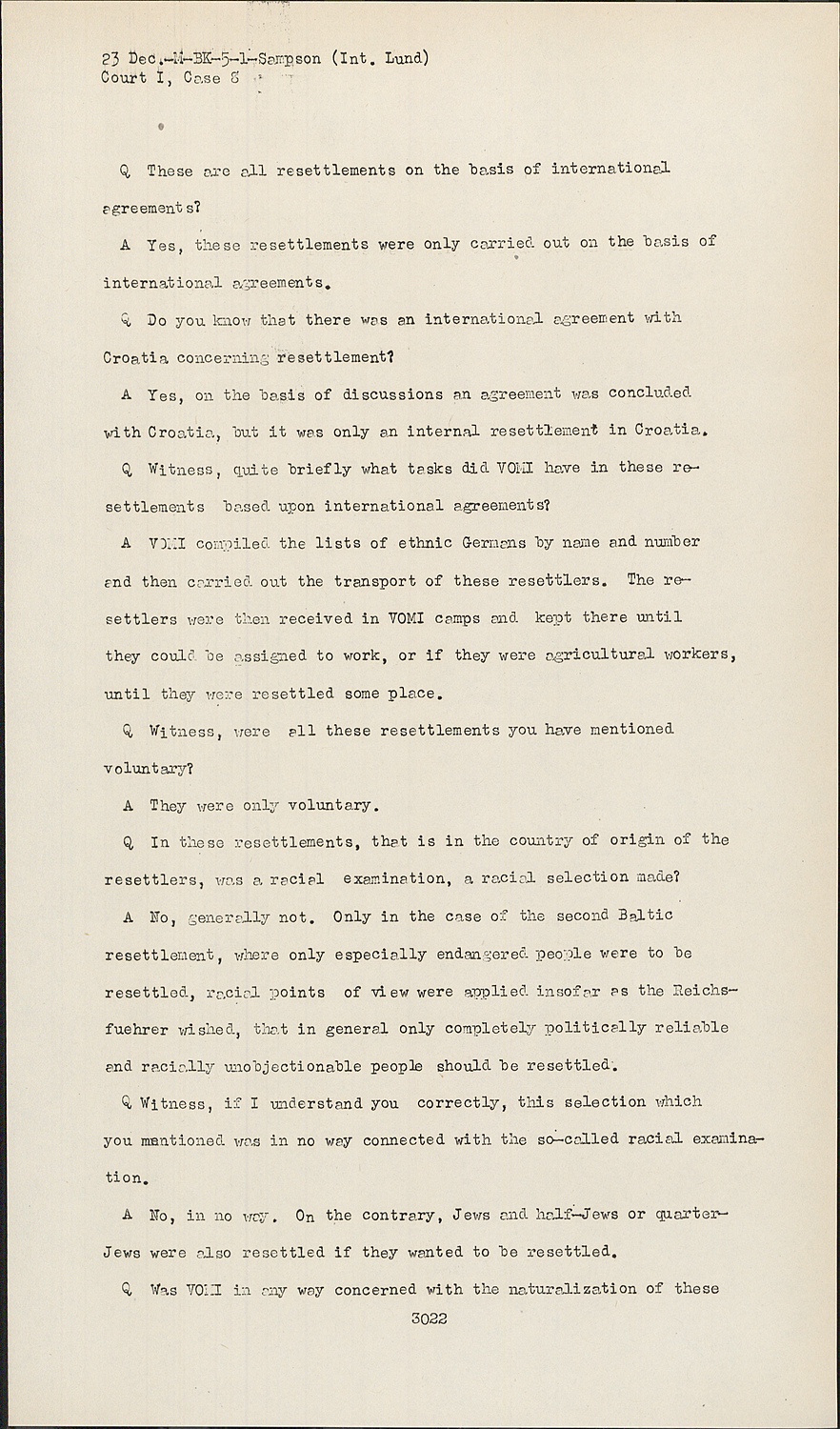
QThese are all resettlements on the "basis of international agreements?
AYes, these resettlements were only carried out on the basis of international agreements.
QDo you know that there was an international agreement with Croatia concerning resettlement?
AYes, on the "basis of discussions an agreement was concluded with Croatia, but it was only an internal resettlement in Croatia.
QWitness, quite briefly what tasks did VOMI have in these resettlements based upon international agreements?
AVOMI compiled the lists of ethnic Germans by name and number and then carried out the transport of these resettlers. The resettlers were then received in VOMI camps and. kept there until they could be assigned to work, or if they were agricultural workers, until they were resettled some place.
QWitness, were all these resettlements you have mentioned voluntary?
AThey were only voluntary.
QIn these resettlements, that is in the country of origin of the resettlers, was a racial examination, a racial selection made?
ANo, generally not. Only in the case of the second Baltic resettlement, where only especially endangered people were to be resettled, racial points of view were applied insofar as the Reichsfuehrer wished, that in general only completely politically reliable and racially unobjectionable people should be resettled.
QWitness, if I understand you correctly, this selection which you mentioned was in no way connected with the so-called racial examination.
ANo, in no way. On the contrary, Jews and half-Jews or quarterJews were also resettled if they wanted to be resettled.
QWas VOMI in any way concerned with the naturalization of these resettlers?
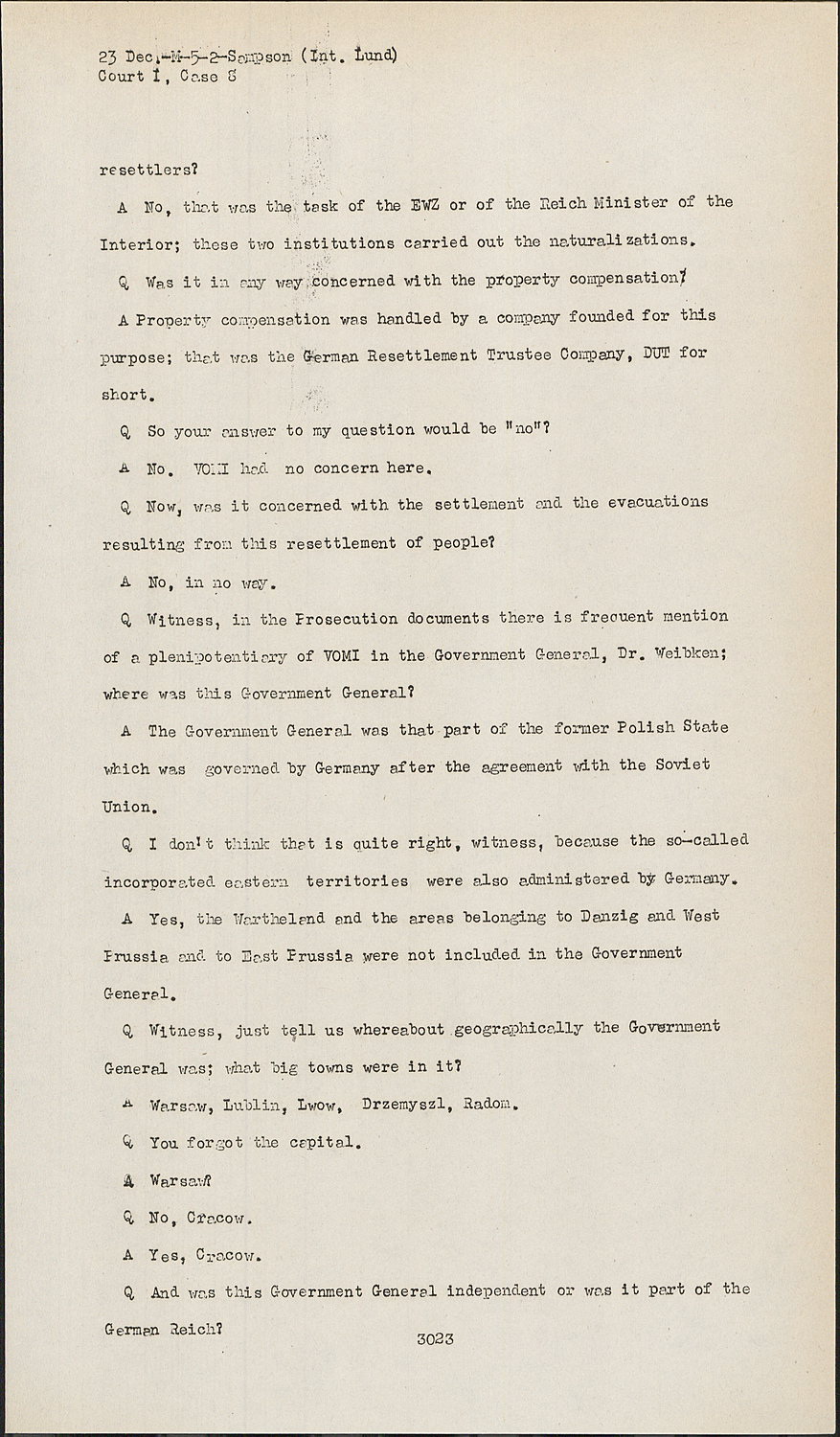
ANo, that was the task of the EWZ or of the Reich Minister of the Interior; these two institutions carried out the naturalizations.
QWas it in my way concerned with the property compensation?
AProperty compensation was handled by a company founded for this purpose; that was the German Resettlement Trustee Company, DUT for short.
QSo your answer to my question would he "no"?
ANo. VOMI had no concern here.
QNow, was it concerned with the settlement and the evacuations resulting from this resettlement of people?
ANo, in no way.
QWitness, in the Prosecution documents there is frequent mention of a plenipotentiary of VOMI in the Government General, Dr. Weibken; where was this Government General?
AThe Government General was that part of the former Polish State which was governed by Germany after the agreement with the Soviet Union.
QI don't think that is quite right, witness, because the so-called incorporated eastern territories were also administered by Germany.
AYes, the Wartheland and the areas belonging to Danzig and West Prussia and to East Prussia were not included in the Government General.
QWitness, just tell us whereabout geographically the Government General was; what big towns were in it?
AWarsaw, Lublin, Lwow, Drzemyszl, Radom.
QYou forgot the capital.
AWarsaw?
QNo, Cracow.
AYes, Cracow.
QAnd was this Government General independent or was it part of the German Reich?
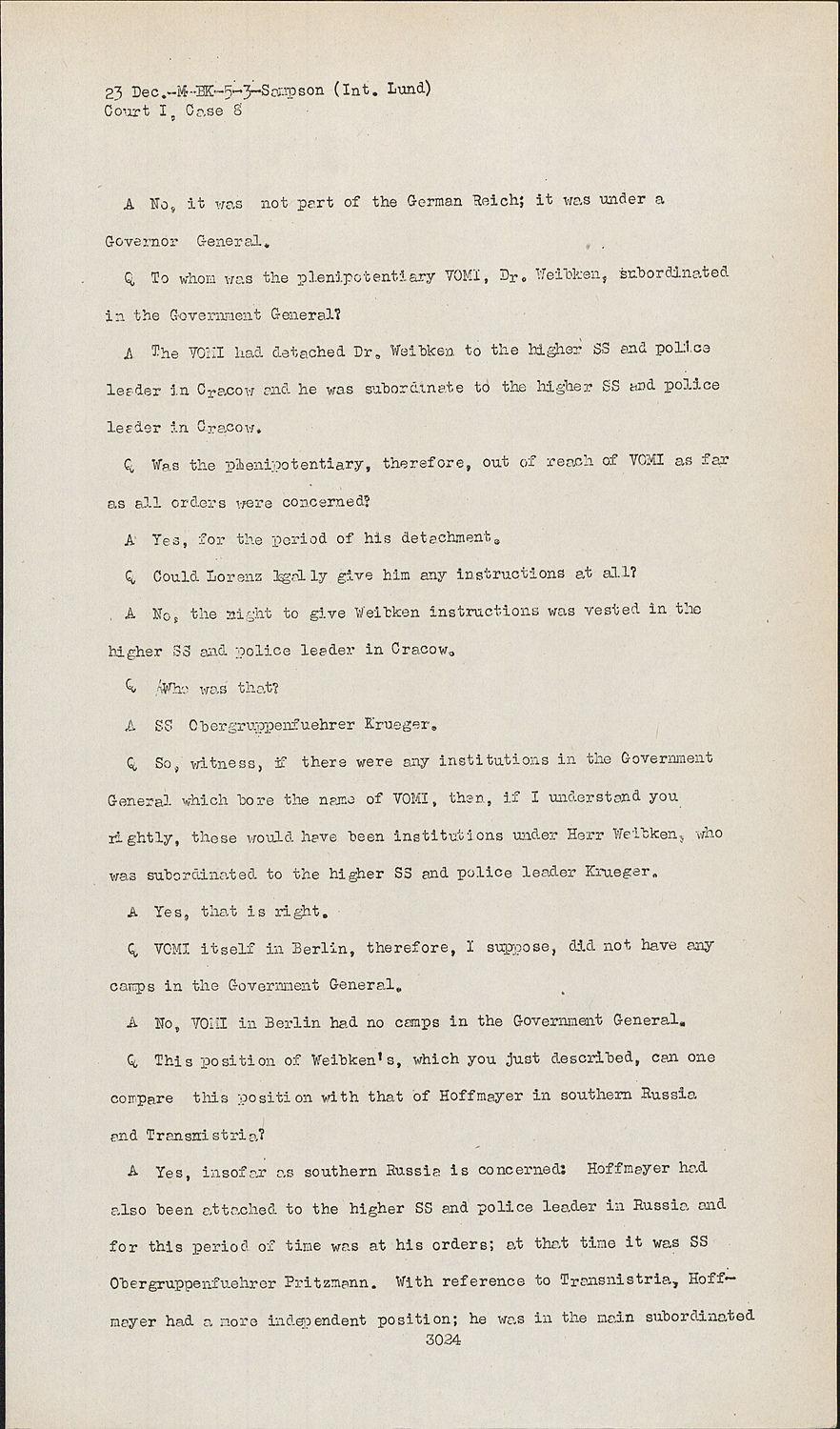
ANo, it was not part of the German Reich; it was under a Governor General.
QTo whom was the plenipotentiary VOMI, Dr. Weibken, subordinated, in the Government General?
AThe VOMI had detached Dr. Weibken to the higher SS and police leader in Cracow and he was subordinate to the higher SS and police leader in Cracow.
QWas the plenipotentiary, therefore, out of reach of VOMI as far as all orders were concerned?
AYes, for the period of his detachment.
QCould Lorenz legally give him any instructions at all?
ANo, the night to give Weibken instructions was vested in the higher SS and police leader in Cracow.
QWho was that?
A SSObergruppenfuehrer Krueger.
QSo, witness, if there were any institutions in the Government General which bore the name of VOMI, then, if I understand you lightly, these would have been institutions under Herr Weibken, who was subordinated to the higher SS and police leader Krueger.
AYes, that is right.
QVOMI itself in Berlin, therefore, I suppose, did not have any carps in the Government General.
ANo, VOMI in Berlin had no camps in the Government General.
QThis position of Weibken's, which you just described, can one compare this position with that of Hoffmayer in southern Russia and Transnistria?
AYes, insofar as southern Russia is concerned: Hoffmayer had also been attached to the higher SS and police leader in Russia and for this period of time was at his orders; at that time it was SS Obergruppenfuehrer Pritzmann. With reference to Transnistria, Hoffmayer had a more independent position; he was in the main subordinated to the Reichsfuehrer SS personally.
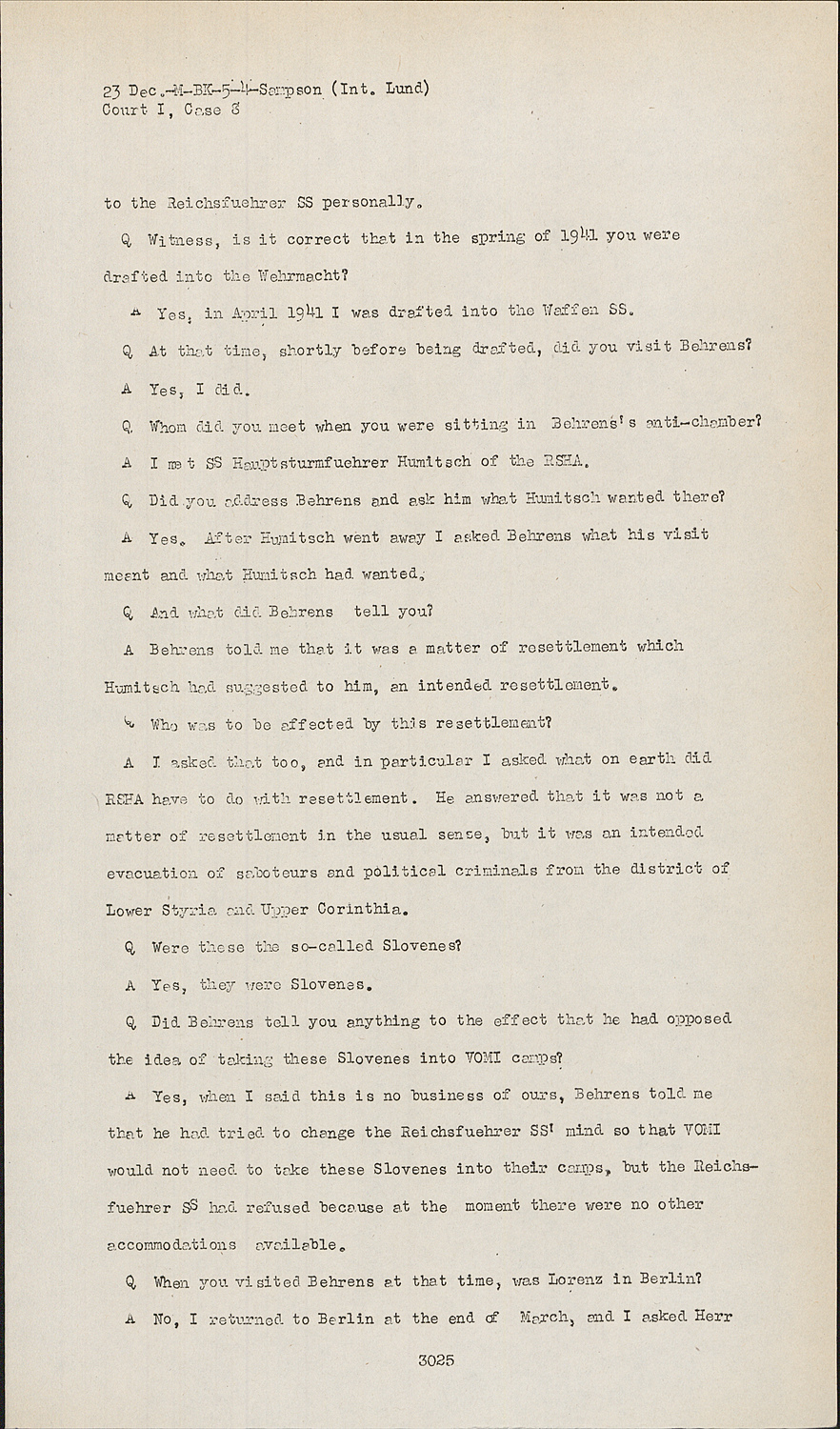
QWitness, is it correct that in the spring of 1941 you were drafted into the Wehrmacht?
AYes, in April 1941 I was drafted into the Waffen SS.
QAt that time, shortly before being drafted, did you visit Behrens?
AYes, I did.
QWhom did you meet when you were sitting in Behrens's anti-chamber?
AI met SS Hauptsturmfuehrer Humitsch of the RSHA.
QDid you address Behrens and ask him what Humitsch wanted there?
AYes. After Humitsch went away I asked Behrens what his visit meant and what Humitsch had wanted.
QAnd what did Behrens tell you?
ABehrens told me that it was a matter of resettlement which Humitsch had suggested to him, an intended resettlement.
QWho was to be affected by this resettlement?
AI asked that too, and in particular I asked what on earth did RSHA have to do with resettlement. He answered that it was not a matter of resettlement in the usual sense, but it was an intended evacuation of saboteurs and political criminals from the district of Lower Styria and Upper Corinthia.
QWere these the so-called Slovenes?
AYes, they were Slovenes.
QDid Behrens tell you anything to the effect that he had opposed the idea of taking these Slovenes into VOMI camps?
AYes, when I said this is no business of ours, Behrens told me that he had tried to change the Reichsfuehrer SS' mind so that VOMI would not need to take these Slovenes into their camps, but the Reichsfuehrer SS had refused because at the moment there were no other accommodations available.
QWhen you visited Behrens at that time, was Lorenz in Berlin?
ANo, I returned to Berlin at the end of March, and I asked Herr Lorenz for permission to go to the front.
That was the last official duty which Herr Lorenz undertook. Then at the beginning of April of that year he left for the southeast, and at the time Humitsch vitised Behrens in Berlin, Herr Lorenz had already left.
QDo you know that Lorenzhad a serious motor accident on this trip?
AYes, when I had been drafted, I got a letter from Behrens that our chief Herr Lorenz had had a serious motor accident in southern Europe.
THE PRESIDENT:The Tribunal will recess for fifteen minutes. May I call Counsel's attention to the fact that during this recess we would like to have a conference with the representative from the Defense and the Prosecution.
(A recess was taken.)
( The hearing reconvened at 1105 hours.)
THE MARSHAL:The Tribunal is again in session.
PRESIDENT: Proceed with the examination.
KONRAD RADUNSKI - Resumed DIRECT EXAMINATION (Continued)
BY DR. SCHUBERT:
Q. Witness, we were talking about the Slovene affair. Did you find out what Lorenz' opinion was about this?
A. Yes, I did. Later on Lorenz tried occasionally to in tercede with the Reichsfuehrer SS that the Slovenes were taken out of the camps of the VOMI but the Reichsfuehrer SS, pointing out that there were no other places for these people, delayed the deci sion again and again and handled this matter in a dictatory manner.
Q. In this matter did the VOMI have anything to do with the deportation of the Slovenes?
A. No, as I learned from Behrens later on, the deportation was carried out by the local security police and by the chief of the civil administration.
Q.You said that Lorenz, when you were at Behrens' place was out of town?
A. Yes.
Q. Was Lorenz absent a lot from Berlin?
A. Yes. Lorenz was travelling quite a lot.
Q. Then if Lorenz wanted to find out about the matters of the VOMI, did he have to rely upon what Behrens reported to him?
A. Yes. Behrens was the person who during the absence of Lorenz represented independently the office.
This even led to the fact that he had the title of deputy chief of the VOMI, that is, he gave himself the title.
Q. Through these constant absences of Lorenz, did it happen that Lorenz was by no means informed throughly about all important matters by Behrens?
A.No. It was up to Behrens to report to Lorenz what he, Behrens, considered important. I know of many incidents which were not told to Lorenz, in particular in connection with the cooperation of Behrens with the security service.
Q.Do you know who paid Lorenz' salary?
A.Lorenz' salary, as the salary of all other membersof the VOMI, was paid by the VOMI itself and the VOMI received its expenditures from the Reich Treasureer of the National Socialist Party.
Q.Do you know whether Lorenz received another salary from the General SS after he became the chief of the VOMI?
A.After becoming head of VOMI he only received salary from the VOMI.
Q.Was the VOMI considered a main office of the SS?
A.No. After Hess left Germany the Reichsfuehrer SS, in the fall of 41, was put in charge of the VOMI, and the VOMI itself was responsible for the sphere of activity which belonged to the Reich Commissioner for the Strengthening of Germanism. It received certain rights that the VOMI was designated Reich Commissioner for the Strengthening of Germanism. The VOMI was never a main office of the SS because the employees of the VOMI neither received a salary from the SS nor did they have any official positions on the SS if they were members of the SS.
Q.I want to ask you concerning two prosecution documents which concern themselves with the regermanization, Prosecution Exhibit 133 in Volume IV B: A report about the EWZ, about the registry of German racials in northern France. Did the VOMI have anything to do with the regermanization of these persons in northern France?
A.No. The VOMI merely had the following to do with the ethnic Germans in northern France and Belgium, in that they were in charge of their cultural life. The VOMI had nothing to do with the germanization. This was a task of the EWZ.
Q.Was this task of the VOMI, namely, to take care of the ethnic Germans -- did this task exist before the war?
A.Yes, That was the actual task of the VOMI, to take care of ethnic Germans abroad.
Q.In the Document 179, Volume IV D, there is talk of attempts of germanization of North American prisoners of war. Do you know anything about this?
A.I do now that the Reichsfuehrer SS once issued an order to have American prisoners of war of German origin looked up in the camps and to submit questions to them concerning their connection with their German relatives and conditions in America particularly with regard to the opinion towards Germany and the propaganda which was conducted against Germany in the United States.
Q.Did you know whether the Reichfuehrer SS intended to isolate these American P.W's?
A.Yes, I heard about that the Reichsfuehrer SS intended to put these PW's into a separate camp in order to be able to talk with them more successfully.
Q.Did this come about?
A.No. The VOMI sent representatives to PW camps who talked with these PWs'. These representatives of the VOMI found out, however that the PW's, although they were conscious that they were of German origin, but felt themselves to be American in every way and on the whole wanted no part of Germany. That was one phase of it, and the other phase of it was that of international law. VOMI requested General Reinecke to find out whether such a separation of PW's was in accordance with international law. General Reinecke obtained an opinion from the Foreign Office, and the answer was in the negative. As a result of these two factors it was decided not to seperate the PW's. To the camps which had been provided for these PW's, no single American PW was ever brought.
DR. SCHUBERT:Thank you, Witness. No further questions.
DR. DOETZER:Dr. Doetzer for the defendant, Brueckner. BY DR. DOETZER:
Q.When did you become acquainted with the defendant Brueckner?
A.I met Brueckner in 1939 -- in November '39.
Q.Did Brueckner at that time belong to the General SS or the Waffen SS?
A.No. Brueckner was conscripted for the resettlement command of the Vomi and belonged neither to the General SS nor the Waffen SS.
Q.You were a personnel expert of the VOMI, were yyou not?
A.Yes.
Q.Can you tell me how it came about that Brueckner around 1940 received an honorary rank in the SS?
A.Well, Brueckner together with other members of the resettlement office, Wolhynia, Golicia, received an honorary rank of a leader as Untersturmfuehrer, Berlin, in 1940.
Q.What is an Untersturmfuehrer?
A.The Untersturmfuehrer corresponded to the rank of a lieutenant in the Wehrmacht.
Q.Why did these members of the resettlement office receive such honorary ranks?
A.In the agreement with the Soviet Union, the Soviet Union had insisted that members of the resettlement command appeared in uniform and performed their service in uniform. For this reason, members of the resettlement office who did not belong to the SS received honorary ranks of SS leaders.
Q.Why did these members of the Vomi--why did they not receive "expert" ranks of the SS?
A.There were no such ranks. These ranks were introduced in '41.
Q.Did Brueckner receive such an expert rank when it was introduced?
A.Yes. He received an expert rank, I believe it was something like Obersturmfuehrer of the Waffen SS.
Q.Was Brueckner drafted to the Waffen SS or did he volunteer for it?
A.Brueckner never volunteered. He was given the rank in the General SS as honorary leader within the scope of his tasks in the resettlement office and his conscription to the Waffen SS was a result of his membership in the resettlement office.
Q.Was Brueckner promoted later on?
A.Brueckner was not really promoted, but it was more a coordination of a rank. It corresponded to the rank in the police.
Q.What rank did Brueckner hold before the collapse, that is, at the moment of the collapse?
A.In the General SS he had the rank of a Sturmbannfuehrer, he had the rank of an Obersturmbannfuehrer of the Waffen SS and in addition he was Unterscharfuehrer of the Waffen SS.
Q.Can you give us the corresponding ranks in the Whermacht?
A.Yes. Sturmbannfuehrer corresponds to the rank of a major, Obersturmbannfuehrer corresponds to the rank of a lieutenant colonel, and Unterscharfuehrer is a non commissioned officer.
Q.Would Brueckner have continued to hold these ranks if he had left the Vomi, that is from his civilian position?
A.No. The expert rank was connected solely with his service in the Vomi. In the document about the granting of ranks there is a consition which says "for the duration of the service", in this case, service with the Vomi. The service rank in the General SS was not permanent for Brueckner. Brueckner was a so-called V-leader, that is to say, he was kept in the seniority lists and other lists and there was a "V" behind his rank which means "temporary", that is, his permanent acceptance into the SS had not taken place.
Q.Was that noticeable on the uniform which he were?
A.Yes. All "V# members of the SS on their lapels did not have a unit insignia or if they were fuehrers they did not have the corresponding lapels with the name of the unit or the main office on it.
Q.Did Brueckner take the SS oath?
A.No.
Q.Did he have to pay membership dues as a temporary member?
A.No, he did not.
Q.Did Brueckner ever perform service in the SS? Or was he obliged to?
A.No, no. All members of the Vomi which belonged to the SS temporarily did not have to perform any service in the SS at any time.
Q.Did he attend SS leadership schools?
A.No.
Q.Did he take part in SS courses?
A.No.
Q.Did he receive SS training literature?
A.Not personally, I am sure.
Q.Witness, as an expert on personnel matters, can you tell me whethe and if so when Brueckner had an independent position in the Vomi?
A.To begin with, Brueckner was a sort of an auxiliary worker for Hoffmeyer, in the resettlement office, later on he was one of the assittant experts of Behrens.
That was up to around the end of '42, the beginning of '43. It was only the beginning of '43 that Brueckner was put in charge of an office.
Q.Can you say something concerning the fact that Brueckner and Behrens ever were allowed to work on matters independently or did they receive definite instructions?
A.No. He could not work independently. Behrens never desired any of his co-workers to become too independent. Brueckner always received exact instructions as to how to behave in matters of his service.
Q.Can you give me an example which expressly shows this?
A.For instance, Brueckner was working on western problems and in this field Behrens reserved himself the right of sole competency and Brueckner had several orders for Northern France and Belgium for which he received exact instructions from Behrens.
Q.Can you remember the Luxembourg order which he received?
A.As far as I know, Brueckner was only once in Luxembourg where he had to inspect the index of ethnic Germans.
Q.You don't remember that exactly, do you?
A.Yes, I do know that.
Q.The ethnic German index -- was that a task of the Vomi or who kept this index?
A.The index of ethnic Germans was set up by the chief of the civilian administration and for this purpose the chief of the administration requested the Vomi to send an expert to Luxembourg. This expert, a Herr Posthaus, set up this index of ethnic Germans on the order of the chief of the civilian administration.
Q.Would this expert be subordinated to Brueckner, or to whom was he subordinated in the Vomi?
A.He was subordinated to Behrens alone because Behrens reserved himsel the right of sole competence in these matters.
Q.Did Brueckner participate in the deportation of Luxembourgians?